Tuesday, June 16, 2026

When the Mission Statement Becomes Fiction: What Byju's Collapse Teaches About Founder Accountability

I've been watching the Byju's story unfold for months now, and the latest chapter hit differently.

The founder just received a six-month prison sentence for contempt of court. Not for fraud. Not for embezzlement. For failing to properly disclose assets during legal proceedings.

This is a company that once valued itself at $22 billion. Forbes later cut the founder's personal net worth to zero. The ed-tech darling that promised to make quality education accessible to millions is now a masterclass in what happens when governance becomes an afterthought.

The irony writes itself.

The Problem Wasn't the Product

Byju's didn't fail because online education is a bad idea. The market for accessible learning is massive and growing. Parents want better options. Students need flexible tools. The problem was never about demand.

The problem was leadership.

When both Deloitte and BDO resign as your auditors due to delayed financial reports and poor communication, that's not a red flag. That's a siren.

Auditor resignations don't happen casually. These firms have reputations to protect. When they walk away, they're telling the market something critical: the financial picture is too unclear or too risky to attach their name to.

Smart investors pay attention to these signals. The public often doesn't hear about them until it's too late.

The Offshore Shell Game

Here's where things get messy.

Lenders accused Byju's of moving over $500 million linked to a term loan without proper disclosure. The money moved through multiple entities, creating a web of transactions that made tracking the actual flow nearly impossible.

Complex offshore structures aren't inherently illegal. Many legitimate businesses use them for tax efficiency or operational flexibility. But when those structures obscure rather than facilitate transparency, you've crossed a line.

The legal battles now span three continents: Singapore, the United States, and India. That's not just complicated. That's a governance failure with global consequences.

When you build a company that operates across borders, you inherit the regulatory obligations of every jurisdiction you touch. Byju's appears to have treated those obligations as suggestions rather than requirements.

The Hubris Factor

There's a pattern in startup failures that doesn't get enough attention: founder hubris.

Charles Koch, who runs a $115 billion family business, put it clearly: "Hubris, arrogance is just one step ahead of loss of integrity. Because if you think you're better than other people, you know more, then you're going to think as many leaders have, that the rules don't apply to them."

Startups are particularly vulnerable to this.

Research shows that the lack of well-defined governance structures in early-stage companies creates low impediments to leadership power. Founders face high uncertainty and can't rely on historical performance data. That combination creates an environment where decision biases flourish.

When you're building fast and breaking things, it's easy to confuse momentum with invincibility. You raise a big round. Valuation climbs. Media coverage grows. Suddenly, the normal rules feel like obstacles designed for slower, less visionary companies.

But gravity doesn't care about your valuation.

The Mission-Management Gap

What bothers me most about the Byju's story isn't the financial complexity or even the legal troubles. It's the gap between what the company said it stood for and how it actually operated.

Byju's positioned itself as a champion of accessible education. The marketing emphasized democratizing learning, empowering students, and breaking down barriers to quality instruction.

But the business model told a different story.

Reports describe aggressive sales tactics, expensive subscription packages targeting anxious parents, and a culture focused more on growth metrics than learning outcomes. The company became what critics now call "a hard-selling business wrapped in the language of learning."

This disconnect matters.

When your mission statement becomes fiction, you're not just misleading customers. You're building a company on a foundation of misalignment. Every decision gets harder because the stated values and actual priorities point in different directions.

Your team feels it. Your customers sense it. Eventually, the market punishes it.

What This Means for the Rest of Us

The Byju's collapse isn't just an ed-tech story. It's a case study in what happens when growth outpaces governance.

If you're building a company, here's what matters:

Financial transparency isn't optional. You can't scale a business on accounting shortcuts and delayed disclosures. The bigger you get, the more scrutiny you face. Build systems that can handle that scrutiny from day one.

Auditor relationships are trust signals. When your auditors resign, the market assumes the worst. Maintain clean books, respond to requests promptly, and treat audit processes as non-negotiable.

Complex structures need clear documentation. If you're moving money across borders or through multiple entities, document everything. Assume every transaction will eventually be reviewed by regulators, lawyers, or journalists.

Mission alignment requires constant vigilance. It's easy to drift from your stated values when growth pressures mount. Regular check-ins on whether your operations match your mission aren't feel-good exercises. They're risk management.

Founder power needs checks. The same vision and conviction that helps you build a company can blind you to problems. Build a board that challenges you. Hire executives who will push back. Create mechanisms that force you to explain and justify major decisions.

The Personal Accountability Question

The six-month prison sentence for Byju Raveendran sends a clear message: courts are willing to hold founders personally accountable for corporate non-compliance.

This matters more than you might think.

For years, the startup world operated under an implicit assumption that corporate liability stayed corporate. Founders might lose their companies or their wealth, but personal legal consequences were rare.

That's changing.

Regulatory bodies are increasingly looking past the corporate veil when they see patterns of evasion or non-compliance. If you're the decision-maker, you own the consequences.

This shift affects how investors evaluate risk. Due diligence now includes deeper scrutiny of founder character, governance practices, and compliance infrastructure. Market potential matters less if leadership integrity is questionable.

The Bigger Picture

I think about the thousands of employees who joined Byju's believing in the mission. The investors who bet on the vision. The parents who paid for subscriptions hoping to give their kids an edge.

All of them deserved better governance.

The ed-tech sector will recover. New companies will emerge with better structures and clearer values. But the Byju's story will remain as a cautionary tale about what happens when you prioritize valuation over integrity.

Building a company is hard. Building one that scales while maintaining ethical standards and operational transparency is harder. But it's the only approach that survives long-term scrutiny.

The market eventually figures out who's building something real and who's just building a story.

Byju's chose the story. Now we're watching what happens when the story falls apart.

The lesson isn't complicated: Your mission statement means nothing if your management practices contradict it. Governance isn't bureaucracy. It's the infrastructure that lets you scale without collapsing under your own weight.

Get it right early, or spend years cleaning up the mess later.

Some companies don't get the chance to clean up. They just collapse.

Monday, June 15, 2026

Massachusetts Just Rewrote the Rules for Gig Workers—And the Rest of the Country Is Watching

Test Gadget Preview Image

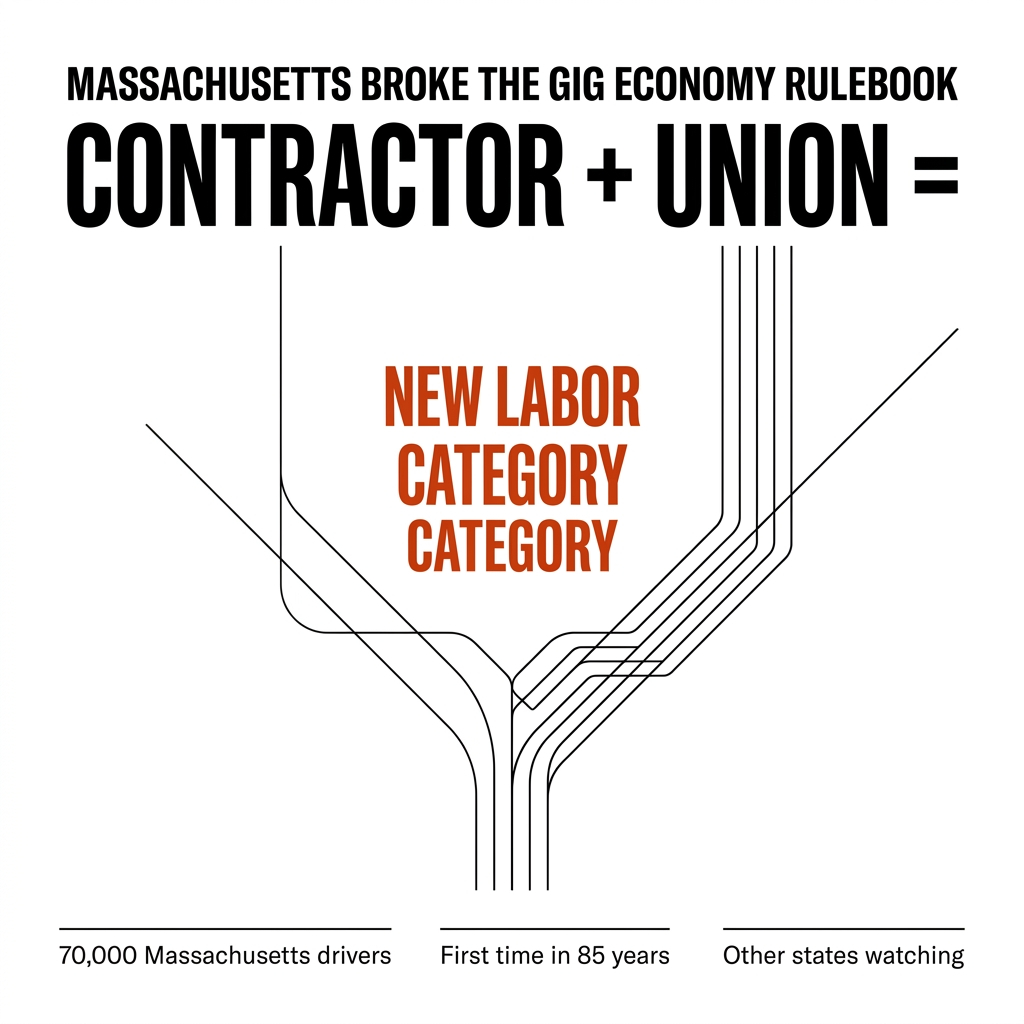
Massachusetts certified the App Drivers Union to represent 70,000 Uber and Lyft drivers in May 2026. Labor leaders called it the largest private-sector organizing victory since Ford autoworkers unionized in 1941.

That 85-year gap tells you something about how rare major labor wins have become in modern America.

But here's what makes this different: the drivers remain independent contractors. They're not employees. They still set their own schedules, pay their own gas, and handle their own vehicle costs. Yet they now have collective bargaining rights.

That combination—collective representation without employee status—is genuinely new territory.

It signals that the legal and economic framework for gig work is being rebuilt in real time. And what happens in Massachusetts could reshape how millions of workers across the country negotiate pay, working conditions, and power with platform companies.

The Legal Paradox That Made This Possible

Under federal law, independent contractors can't collectively bargain. The National Labor Relations Act explicitly excludes them. The reason? Antitrust concerns. When independent contractors band together to negotiate prices or terms, federal law treats it as illegal collusion.

That's the legal wall gig workers have been hitting for years.

Massachusetts found a workaround. In 2024, voters approved a ballot measure with 54% support. It created a first-in-the-nation framework allowing ride-hailing drivers to unionize and bargain collectively while keeping their independent contractor status. Chapter 150F of Massachusetts General Law specifically exempts rideshare companies and driver organizations from certain federal and state antitrust laws when they negotiate together.

The state essentially said: we're creating a third category. You're not an employee. You're not a traditional contractor. You're something in between—and you get some protections from both worlds.

This isn't theoretical. It's already certified. The union exists. Negotiations can begin.

Why Drivers Organized Now

The push for collective bargaining didn't come from nowhere. Drivers have been dealing with rising vehicle costs, fluctuating pay, and opaque app algorithms for years. They pay for gas, insurance, maintenance, and vehicle wear themselves. When their income drops or expenses spike, they absorb the hit.

Before the 2024 settlement, Massachusetts Attorney General Andrea Campbell secured a $175 million resolution requiring a $32.50 hourly minimum pay standard. That highlighted the economic pressures drivers face—and showed that legal action could force changes.

But there's another factor: automation. Waymo has expanded driverless taxi operations in cities including San Francisco, Los Angeles, and Phoenix. Massachusetts currently requires human operators in autonomous vehicles, but drivers across the country regularly communicate with one another about changing conditions in the industry.

They see what's coming. Organizing now gives them leverage before the technology displaces them entirely.

What Collective Bargaining Actually Means for Gig Workers

Collective bargaining isn't just about wages. It's about power.

When you bargain individually with a platform company, you have no leverage. You accept the terms or you stop driving. When 70,000 drivers bargain collectively, the company has to listen.

Here's what drivers can now negotiate:

  • Minimum pay standards that account for time, distance, and expenses

  • Transparency around algorithms that determine which drivers get which rides

  • Deactivation policies that currently let companies remove drivers without clear recourse

  • Safety protections including insurance coverage and support after incidents

  • Benefits access such as health insurance, retirement contributions, or paid time off

None of this converts drivers into employees. They still control when and where they work. But it does shift the balance of power in contract terms.

That's the innovation here. Massachusetts created a model where workers can organize without triggering the legal reclassification battles that have dominated gig economy fights for the past decade.

The Dependent Contractor Concept Gains Ground

Legal scholars have been arguing for years that the employee-contractor binary doesn't fit modern work arrangements. People like Andrew Stewart and Jim Stanford have pushed for "dependent contracting" as a policy bridge.

The idea: acknowledge gig workers' operational independence while recognizing their structural dependence on platform companies for income, work allocation, and terms.

Canada already uses this hybrid classification model. Workers in that category get some protections without full employee status. Massachusetts is building something similar, but through collective bargaining rights instead of individual benefit mandates.

Experts predict this will accelerate the emergence of hybrid classifications—a third category of worker who retains independence but receives partial benefits and protections.

We're watching labor law evolve in real time. The question isn't whether these hybrid models will spread. It's how fast and how far.

Why This Matters Beyond Massachusetts

Governor Maura Healey said it directly: "This changes the game for rideshare workers across this country."

She's right. Massachusetts just provided a template.

Labor organizers in California and Illinois are already targeting app-based industries with similar campaigns. They're watching what happens in Massachusetts to see if the model holds up under legal challenges and whether it delivers meaningful improvements for workers.

If it does, other states will copy it. If it doesn't, they'll learn from the gaps.

Platform companies are watching too. Uber and Lyft have spent years fighting employee reclassification efforts. California's Proposition 22 was their biggest win—voters approved a measure keeping gig workers as contractors while adding limited benefits.

But Massachusetts takes a different approach. It doesn't reclassify workers. It just gives them collective power. That's harder to fight because it doesn't trigger the same legal battles over employment status.

Companies now face a strategic decision: negotiate in good faith and shape the terms, or resist and risk more aggressive regulation down the line.

What This Means for Business Strategy

If you run a platform business or rely on independent contractors, this matters to you.

The Massachusetts model shows that states can create new labor frameworks without waiting for federal action. That means the rules could vary widely by location. What works in one state might not fly in another.

Here's what to watch:

Operational costs will shift. Collective bargaining agreements could raise pay floors, add benefit contributions, or require new safety investments. You'll need to model those costs before they hit.

Transparency will increase. Algorithm-driven work allocation has been a black box. Unions will push for clarity. If you can't explain how your system works, you'll face pressure to change it.

Deactivation policies will tighten. Right now, platforms can remove workers with limited explanation. Collective agreements will likely require due process, appeal mechanisms, and clearer standards.

Geographic complexity will grow. If multiple states adopt different hybrid models, you'll manage a patchwork of labor rules. That adds compliance costs and operational friction.

Competitive dynamics will change. Companies that negotiate effectively with organized workers could gain stability and reduce turnover. Those that resist could face strikes, regulatory scrutiny, or talent shortages.

The smartest companies won't wait for regulation to force their hand. They'll engage early, shape the terms, and build systems that work for both sides.

The Bigger Shift Underneath All of This

The Massachusetts union certification isn't just about ride-hailing drivers. It's about what happens when the traditional employment model stops fitting how people actually work.

Millions of workers now earn income through platforms, freelance arrangements, and project-based contracts. They want flexibility. They don't want to be locked into 9-to-5 schedules or single employers. But they also want stability, fair pay, and some protection when things go wrong.

The old binary—employee or contractor—doesn't solve that. It forces a choice between flexibility and security.

What Massachusetts did was refuse that choice. It said: you can have both. Not perfectly. Not without tradeoffs. But you can have some of each.

That's the real innovation. Not the legal mechanics. Not the union certification process. The recognition that work is changing and the rules need to change with it.

We're in the early stages of that shift. The legal frameworks are still being tested. The economic models are still being proven. The political coalitions are still forming.

But the direction is clear. The rigid categories that defined labor law for the past century are breaking down. What replaces them will be messier, more varied, and more responsive to how people actually want to work.

Massachusetts just took a big step in that direction. The rest of the country is watching to see if it works.

What Comes Next

The union is certified. Now comes the hard part: negotiating the first contract.

That's where theory meets reality. Both sides will test what collective bargaining actually means when the workers aren't employees. They'll figure out what's negotiable, what's off the table, and what happens when they can't agree.

If the first contract delivers meaningful improvements without crippling the business model, other states will move fast. If it stalls or produces weak results, momentum will slow.

Either way, the experiment is running. The data will come in. And business leaders, policymakers, and workers across the country will adjust their strategies based on what happens in Massachusetts.

The legal and economic framework for gig work is being rebuilt in real time. You're watching it happen. And if you run a business that relies on flexible labor, you need to understand what's changing before it changes the rules on you.

The Massachusetts model won't be the last word. But it's the first real test of whether collective bargaining can work outside the traditional employment relationship.

The answer to that question will shape how millions of people work for the next decade.

Monday, June 8, 2026

When Government Becomes Your Shareholder: What the Quantum Computing Equity Stakes Mean for Tech Investment

Test Gadget Preview Image

I've spent years watching how governments fund technology companies. Grants. Contracts. Tax incentives. Loan guarantees.

What happened in May 2026 was different.

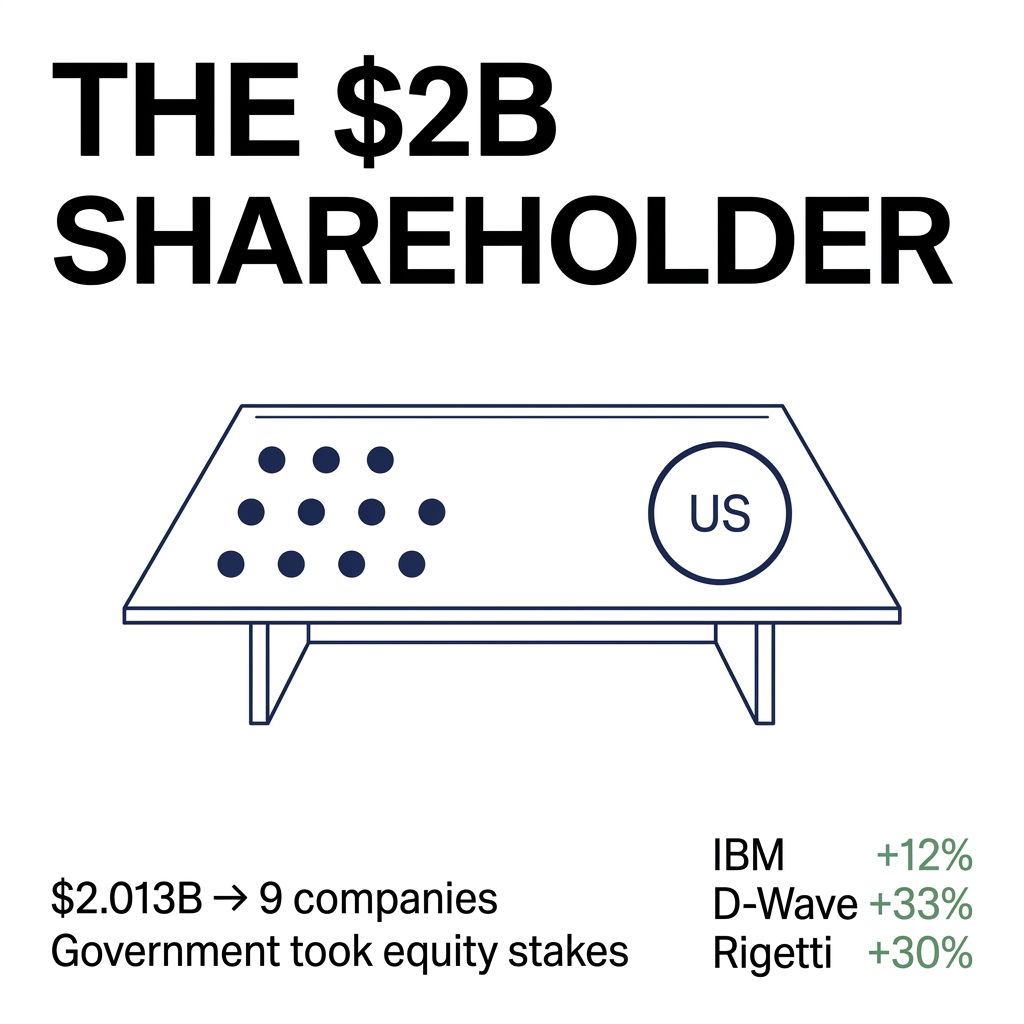
The U.S. Department of Commerce announced it would distribute $2.013 billion in CHIPS Act funding to nine quantum computing companies. That part sounds normal. The unusual part: the government took equity stakes as a condition of receiving the money.

IBM, D-Wave, Rigetti, and six others didn't just get government funding. They got a government shareholder.

The market responded immediately. IBM shares gained 12% on announcement day. D-Wave jumped 33%. Rigetti soared 30%. Infleqtion skyrocketed 31%.

Those numbers tell you something important: investors see government equity participation as a signal of legitimacy and reduced risk. The U.S. government is now betting its own capital on which companies will lead the quantum computing revolution.

That changes the game for everyone involved.

How This Deal Actually Works

The mechanics matter here. This isn't a loan. It's not a grant you spend and forget about.

Take D-Wave as an example. The company received $100 million in funding. In exchange, D-Wave issued shares of its common stock directly to the U.S. Department of Commerce. The government now owns a minority, non-controlling stake in the company.

The structure is clever. D-Wave gets capital without traditional debt obligations. No interest payments. No repayment schedule. The government gets upside potential if D-Wave succeeds.

But here's what most people miss: the government also gets a seat at the table.

You're not just accountable to private investors anymore. You're accountable to a shareholder with policy objectives, national security concerns, and political pressures that have nothing to do with quarterly earnings.

The Precedent Nobody's Talking About

This isn't the first time the U.S. government took equity stakes in a tech company. It happened with Intel in August 2025 under the same CHIPS Act framework.

Commerce Secretary Howard Lutnick pushed for the government to take a nearly 10% stake in Intel. The quantum computing deals extend that model to an entirely new sector.

What started as a one-time experiment with semiconductors is now becoming a pattern. The government is moving from passive regulator to active investor in strategic technology sectors.

That shift has implications most founders and investors haven't processed yet.

The Valuation Paradox You Need to Understand

D-Wave's revenue last year was just under $25 million. Not billion. Million.

Yet the company received $100 million in government funding and saw its share price surge 33% in a single day.

This demonstrates something critical about emerging technology sectors: investors and governments are betting on future potential, not current profitability.

In mature industries, you value companies on cash flow, earnings multiples, and historical performance. In quantum computing, you're valuing them on technical progress, talent acquisition, and the possibility they'll solve problems that don't have commercial applications yet.

The government's equity participation amplifies this dynamic. When the U.S. Department of Commerce becomes your shareholder, it signals to the market that your technology has strategic importance beyond immediate revenue generation.

That changes how other investors value you. It changes your hiring power. It changes your ability to attract partnerships.

But it also creates a new kind of risk.

The Hidden Costs of Government Ownership

I've watched companies celebrate government contracts only to discover the compliance burden, reporting requirements, and political scrutiny that come with them.

Equity stakes are different. They're permanent until the government decides to exit.

Think about what that means for your exit strategy. If you're planning to sell your company, you now need government approval. If you want to pivot your business model, you need to consider how that affects a shareholder with national security concerns.

Your intellectual property strategy changes. Your hiring decisions change. Your international expansion plans change.

A senior Commerce Department official acknowledged that returns could take years to materialize. That's government-speak for "we're willing to wait longer than private investors."

That patience can be valuable. It can also create misaligned incentives.

Private investors want growth and exits. Government investors want strategic capability and domestic production. Those goals sometimes align. Sometimes they don't.

The Portfolio Approach: Government as Venture Capitalist

The government isn't betting on a single quantum computing architecture. It's funding companies working on different technical approaches: superconducting qubits, trapped ions, photonic systems, neutral atoms.

This is sophisticated portfolio theory in action. When you don't know which technology will win, you fund multiple approaches and let the market determine success.

Venture capitalists do this all the time. They know most investments will fail. They're looking for the one or two that generate outsized returns.

The government is applying the same logic. It's hedging its bets across the quantum computing landscape because the winning technology is unclear and timelines remain uncertain.

For founders, this creates an interesting dynamic. You're competing with other portfolio companies for market share, but you're all owned by the same investor. That investor has an interest in the sector succeeding, not necessarily in your specific company dominating.

That's different from traditional competition.

What IBM's CEO Gets Right About Timing

IBM CEO Arvind Krishna made a comparison that deserves attention. He said the current moment in quantum computing is similar to where AI chips stood roughly a decade ago.

In 2015, AI chips were a research curiosity. By 2025, they were the foundation of a multi-trillion-dollar industry transformation.

Krishna is telling you quantum computing is transitioning from research to commercial reality. The government's $2 billion investment signals confidence that this transition is happening soon.

But timing matters enormously in technology investment. Enter too early and you burn capital waiting for markets to develop. Enter too late and you miss the value creation.

The government's equity stakes suggest officials believe we're in the early-but-not-too-early window. That's a signal worth paying attention to.

The Capital Race Context

The government's $2 billion investment isn't happening in isolation.

The quantum computing sector attracted over $1.25 billion in the first quarter of 2025 alone. That's more than double the $550 million raised in Q1 2024. By September 2025, the first three quarters had seen $3.77 billion in total equity funding.

Private capital is flooding into quantum computing at unprecedented rates. The government is joining that race, not leading it.

But government participation changes the dynamics. It validates the sector for institutional investors who were waiting for a signal. It creates a floor under valuations. It signals that quantum computing has moved from speculative to strategic.

That shift attracts more capital, which accelerates development, which attracts more capital. You're watching a feedback loop form in real time.

What This Means for Founders

If you're building a company in quantum computing or any strategic technology sector, you need to think differently about government funding now.

The equity stake model introduces new variables into your cap table, your governance structure, and your exit planning. You need to understand those variables before you take government money.

Questions to ask:

  • What percentage of equity is the government requesting?
  • What governance rights come with that equity?
  • What reporting requirements and compliance obligations are attached?
  • How does government ownership affect your ability to raise future rounds from private investors?
  • What restrictions exist on international partnerships or sales?
  • What happens to the government's stake if you're acquired or go public?

These aren't theoretical questions. They have real implications for your business trajectory.

The government can be a patient, supportive investor. It can also be a complicated partner with objectives that don't align with traditional business metrics.

You need to know which version you're getting before you sign.

What This Means for Investors

If you're evaluating investments in quantum computing companies, government equity participation changes your due diligence.

You need to understand the terms of the government's stake. You need to know what rights they have, what restrictions exist, and how their presence affects your potential returns.

Government ownership can be a positive signal. It reduces certain risks. It provides capital cushion. It creates strategic validation.

But it also introduces new risks. Political risk. Bureaucratic risk. Misaligned incentive risk.

The companies that received government equity stakes in May 2026 saw immediate share price appreciation. That's market enthusiasm. The question is whether that enthusiasm is justified by the fundamentals or driven by the novelty of the structure.

You need to separate signal from noise.

The Broader Pattern Emerging

Step back and look at what's happening across multiple sectors.

The government took equity in Intel for semiconductors. It took equity in nine quantum computing companies. It's exploring similar models in AI infrastructure, advanced materials, and biotechnology.

This isn't a one-time experiment. It's a new industrial policy framework.

The U.S. government is moving from arms-length regulator to active participant in strategic technology development. That shift reflects a view that market forces alone won't produce the technological capabilities needed for national security and economic competitiveness.

Whether you agree with that view or not, you need to adapt to the reality it creates.

Companies building critical technologies will increasingly face a choice: take government equity investment or compete against companies that do. That's not an easy choice. Both paths have tradeoffs.

What Happens Next

The quantum computing equity stakes are less than a year old. We don't know yet how this model will play out in practice.

We don't know how government ownership will affect company decision-making. We don't know how it will impact M&A activity. We don't know how it will influence international partnerships.

What we do know is that the relationship between government and technology companies has changed in a fundamental way. The government isn't just funding research anymore. It's not just setting regulations. It's taking ownership positions in companies it believes will shape the future.

That creates opportunities for some companies and constraints for others. Your job is to figure out which category you're in and plan accordingly.

The rules of tech investment, competition, and exit strategy have changed. Most founders and investors haven't processed that yet.

The ones who do will have an advantage.

Friday, June 5, 2026

Your Employees Are About to Ask Who Owns the AI Profits

Test Gadget Preview Image

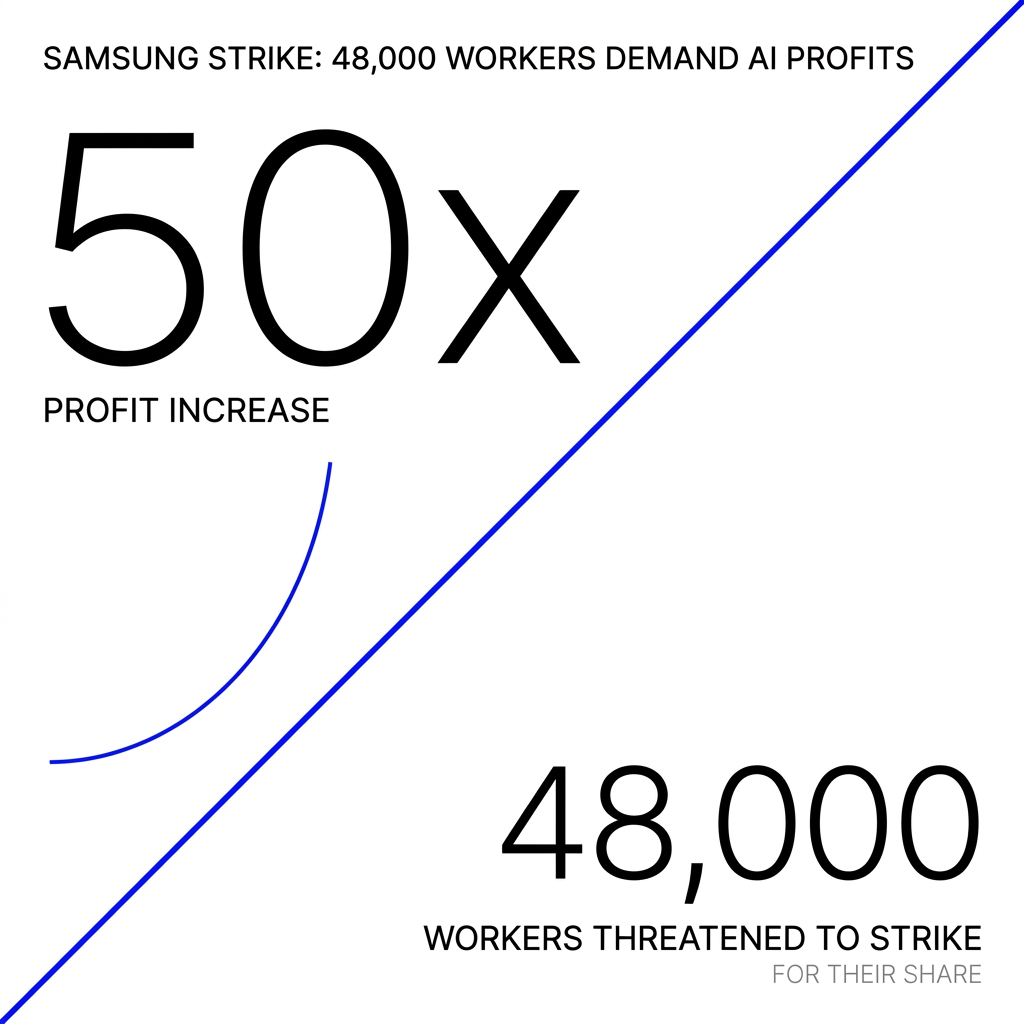
Samsung nearly faced the largest strike in its history earlier this year. Not over layoffs. Not over wages. Over who gets the money AI is making.

More than 48,000 workers—nearly 40% of Samsung's Korean workforce—threatened to walk out for 18 days. The reason? The company's memory chip division reported a nearly 50-fold rise in income driven by surging AI demand. Employees wanted their share.

They got it. Samsung settled with bonuses totaling approximately €350,000 per worker, with semiconductor employees receiving 10.5% of the company's operating earnings.

This wasn't a one-off labor dispute. This was the first major flashpoint over who owns the upside when AI drives productivity. And it won't be the last.

The Profit Explosion Nobody Planned For

AI isn't just changing how work gets done. It's changing how much money companies make from that work.

Total memory revenues jumped from $226 billion in 2025 to a projected $594.7 billion in 2026. That's not incremental growth. That's a structural shift in who captures value.

Samsung's memory chip workers saw this happening in real time. Their labor built the chips. AI demand made those chips wildly profitable. But the initial bonus proposal didn't reflect that reality.

Samsung offered its 27,000 memory chip workers bonuses equivalent to 607% of their annual salary. Sounds generous until you realize the company proposed giving 23,000 workers in logic chip and foundry businesses only 50% to 100% of salary.

Same buildings. Same company. Six times the difference.

That disparity exposed something uncomfortable: when AI generates asymmetric wealth inside organizations, traditional compensation models break down fast.

The Precedent Other Companies Are Watching

Samsung's settlement didn't happen in isolation. Competitor SK Hynix had already agreed to allocate 10% of annual operating profit directly to employees for the next decade. In 2026, that translated to average payouts between $460,000 and $477,000 per worker.

Now other Korean companies are facing similar demands. Employees at LG, Kakao, Hyundai Motor, and Kia are asking for AI-related bonuses tied to operating profit. Some are threatening strikes if their terms aren't met.

The pattern is clear: labor is claiming a percentage of AI-driven gains, not just asking for raises.

This isn't happening because workers oppose AI. It's happening because they see the productivity gains showing up in earnings reports but not in their compensation.

The AFL-CIO put it plainly: "AI has the potential to unleash prosperity that improves working conditions and lifts us all up. But if left unchecked in the hands of corporate profiteers, AI will increase economic inequality, curtail our rights and undermine our democracy."

Translation: labor isn't anti-technology. It's pro-equity in technology gains.

The Contradiction Companies Are Creating

Here's where the tension gets sharper.

By the end of 2026, 54% of companies will have cut employee compensation to fund AI efforts. Another 26% will have laid off workers for the same reason. Meanwhile, 92% of companies say AI investment is a higher priority than employee satisfaction.

Read that again. Companies are cutting worker pay to fund the technology that's generating record profits.

That's not a sustainable strategy. That's a recipe for labor unrest.

Employees aren't blind to the math. They see AI productivity gains flowing to shareholders while their compensation stagnates or shrinks. They see earnings calls celebrating AI-driven margins while their teams get smaller and their workloads grow.

Samsung's near-strike wasn't about rejecting AI. It was about rejecting the idea that only capital should benefit when AI works.

What This Means for Your Business

You don't need to run a semiconductor company to feel this coming.

If your business uses AI to increase output, reduce costs, or improve margins, your employees will eventually ask the same question Samsung's workers asked: where's our share?

The answer you give matters. Not just for morale, but for your ability to attract and retain talent in an AI-driven economy.

Consider what's already shifting:

Collective bargaining is evolving. The International Alliance of Theatrical Stage Employees now includes principles ensuring "the fruits of increased productivity through AI are shared equitably among all stakeholders." Unions aren't negotiating wages in isolation anymore. They're negotiating AI profit-sharing.

Policy is catching up. California Governor Gavin Newsom floated the idea of "universal basic capital"—a policy where workers own a piece of technology disruption. The concept could take several forms: mandatory equity grants for displaced workers, state-level capital pools funded by taxes on AI gains, or voluntary corporate profit-sharing with tax incentives.

Compensation models are being questioned. Traditional salary structures assume labor contributes a fixed percentage of value. AI breaks that assumption. When a single engineer's work gets amplified 10x or 100x by AI tools, how do you price that contribution? When AI automates entire workflows, who owns the resulting margin expansion?

These aren't hypothetical questions. They're showing up in boardrooms, HR meetings, and union negotiations right now.

The Position You Need Before Employees Force One

Samsung had to settle during a strike threat. That's not the position you want to be in.

Better to develop a clear stance before your employees organize around one. Here's what that looks like in practice:

Acknowledge the productivity shift. If AI is making your business more profitable, say so. Employees already know. Pretending otherwise erodes trust.

Define how gains get shared. You don't need to copy SK Hynix's 10% model, but you need a model. Will you tie bonuses to AI-driven performance? Offer equity? Create profit-sharing pools? The specifics matter less than having a transparent answer.

Differentiate between displacement and augmentation. If AI replaces jobs, that's one conversation. If AI amplifies existing roles, that's another. Be clear about which scenario applies to your business and what it means for compensation.

Involve employees early. Samsung's mistake wasn't the initial offer. It was making the offer without input from the people who built the chips. When workers feel excluded from decisions about AI-driven value, they organize. When they feel included, they collaborate.

Prepare for the long game. This isn't a one-time negotiation. AI adoption will continue reshaping how value gets created and captured. Your position today needs room to evolve as that technology matures.

The Real Risk Isn't the Technology

AI will keep driving productivity gains. That's not in question.

The question is whether those gains create shared prosperity or concentrated wealth. Samsung's near-strike proved that employees won't passively accept the latter.

The companies that navigate this well will treat AI profit-sharing as a strategic priority, not a reactive concession. They'll build compensation models that reflect the new economics of AI-amplified work. They'll engage employees in defining what fairness looks like when machines multiply output.

The companies that don't will face strikes, talent flight, and reputational damage.

You have time to get ahead of this. But not much. Samsung's workers gave their leadership 18 days. Your employees might give you less.

The question isn't whether AI will reshape labor economics. It already has. The question is whether you'll shape your company's response or wait for your employees to shape it for you.

Start now. Define your position. Communicate it clearly. Because the conversation about who owns AI's upside is happening whether you're ready or not.

Healthcare's Perverse Incentive: Why AI Is Rebuilding Medicine from the Business Model Up

American healthcare has a structural problem that no amount of medical innovation can fix. The business model is broken at the foundation. U...