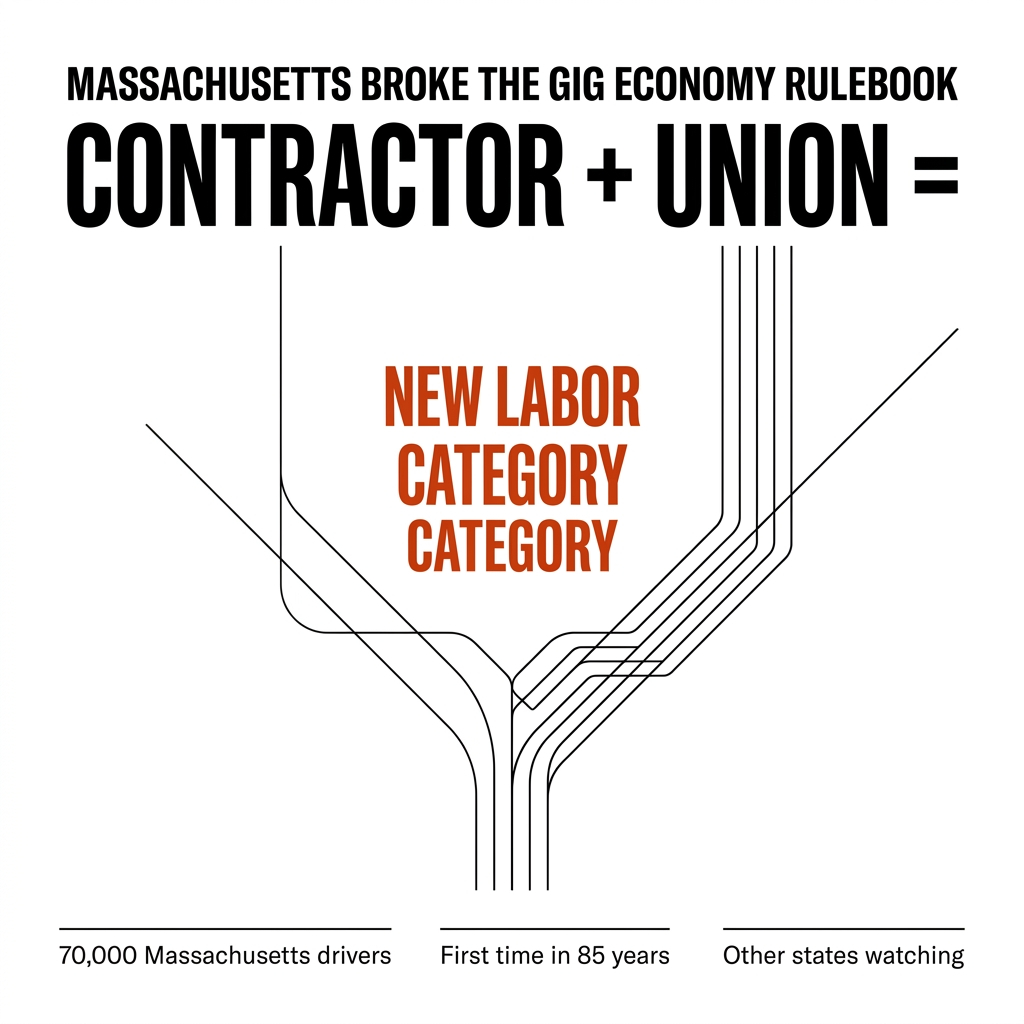
Massachusetts certified the App Drivers Union to represent 70,000 Uber and Lyft drivers in May 2026. Labor leaders called it the largest private-sector organizing victory since Ford autoworkers unionized in 1941.
That 85-year gap tells you something about how rare major labor wins have become in modern America.
But here's what makes this different: the drivers remain independent contractors. They're not employees. They still set their own schedules, pay their own gas, and handle their own vehicle costs. Yet they now have collective bargaining rights.
That combination—collective representation without employee status—is genuinely new territory.
It signals that the legal and economic framework for gig work is being rebuilt in real time. And what happens in Massachusetts could reshape how millions of workers across the country negotiate pay, working conditions, and power with platform companies.
The Legal Paradox That Made This Possible
Under federal law, independent contractors can't collectively bargain. The National Labor Relations Act explicitly excludes them. The reason? Antitrust concerns. When independent contractors band together to negotiate prices or terms, federal law treats it as illegal collusion.
That's the legal wall gig workers have been hitting for years.
Massachusetts found a workaround. In 2024, voters approved a ballot measure with 54% support. It created a first-in-the-nation framework allowing ride-hailing drivers to unionize and bargain collectively while keeping their independent contractor status. Chapter 150F of Massachusetts General Law specifically exempts rideshare companies and driver organizations from certain federal and state antitrust laws when they negotiate together.
The state essentially said: we're creating a third category. You're not an employee. You're not a traditional contractor. You're something in between—and you get some protections from both worlds.
This isn't theoretical. It's already certified. The union exists. Negotiations can begin.
Why Drivers Organized Now
The push for collective bargaining didn't come from nowhere. Drivers have been dealing with rising vehicle costs, fluctuating pay, and opaque app algorithms for years. They pay for gas, insurance, maintenance, and vehicle wear themselves. When their income drops or expenses spike, they absorb the hit.
Before the 2024 settlement, Massachusetts Attorney General Andrea Campbell secured a $175 million resolution requiring a $32.50 hourly minimum pay standard. That highlighted the economic pressures drivers face—and showed that legal action could force changes.
But there's another factor: automation. Waymo has expanded driverless taxi operations in cities including San Francisco, Los Angeles, and Phoenix. Massachusetts currently requires human operators in autonomous vehicles, but drivers across the country regularly communicate with one another about changing conditions in the industry.
They see what's coming. Organizing now gives them leverage before the technology displaces them entirely.
What Collective Bargaining Actually Means for Gig Workers
Collective bargaining isn't just about wages. It's about power.
When you bargain individually with a platform company, you have no leverage. You accept the terms or you stop driving. When 70,000 drivers bargain collectively, the company has to listen.
Here's what drivers can now negotiate:
Minimum pay standards that account for time, distance, and expenses
Transparency around algorithms that determine which drivers get which rides
Deactivation policies that currently let companies remove drivers without clear recourse
Safety protections including insurance coverage and support after incidents
Benefits access such as health insurance, retirement contributions, or paid time off
None of this converts drivers into employees. They still control when and where they work. But it does shift the balance of power in contract terms.
That's the innovation here. Massachusetts created a model where workers can organize without triggering the legal reclassification battles that have dominated gig economy fights for the past decade.
The Dependent Contractor Concept Gains Ground
Legal scholars have been arguing for years that the employee-contractor binary doesn't fit modern work arrangements. People like Andrew Stewart and Jim Stanford have pushed for "dependent contracting" as a policy bridge.
The idea: acknowledge gig workers' operational independence while recognizing their structural dependence on platform companies for income, work allocation, and terms.
Canada already uses this hybrid classification model. Workers in that category get some protections without full employee status. Massachusetts is building something similar, but through collective bargaining rights instead of individual benefit mandates.
Experts predict this will accelerate the emergence of hybrid classifications—a third category of worker who retains independence but receives partial benefits and protections.
We're watching labor law evolve in real time. The question isn't whether these hybrid models will spread. It's how fast and how far.
Why This Matters Beyond Massachusetts
Governor Maura Healey said it directly: "This changes the game for rideshare workers across this country."
She's right. Massachusetts just provided a template.
Labor organizers in California and Illinois are already targeting app-based industries with similar campaigns. They're watching what happens in Massachusetts to see if the model holds up under legal challenges and whether it delivers meaningful improvements for workers.
If it does, other states will copy it. If it doesn't, they'll learn from the gaps.
Platform companies are watching too. Uber and Lyft have spent years fighting employee reclassification efforts. California's Proposition 22 was their biggest win—voters approved a measure keeping gig workers as contractors while adding limited benefits.
But Massachusetts takes a different approach. It doesn't reclassify workers. It just gives them collective power. That's harder to fight because it doesn't trigger the same legal battles over employment status.
Companies now face a strategic decision: negotiate in good faith and shape the terms, or resist and risk more aggressive regulation down the line.
What This Means for Business Strategy
If you run a platform business or rely on independent contractors, this matters to you.
The Massachusetts model shows that states can create new labor frameworks without waiting for federal action. That means the rules could vary widely by location. What works in one state might not fly in another.
Here's what to watch:
Operational costs will shift. Collective bargaining agreements could raise pay floors, add benefit contributions, or require new safety investments. You'll need to model those costs before they hit.
Transparency will increase. Algorithm-driven work allocation has been a black box. Unions will push for clarity. If you can't explain how your system works, you'll face pressure to change it.
Deactivation policies will tighten. Right now, platforms can remove workers with limited explanation. Collective agreements will likely require due process, appeal mechanisms, and clearer standards.
Geographic complexity will grow. If multiple states adopt different hybrid models, you'll manage a patchwork of labor rules. That adds compliance costs and operational friction.
Competitive dynamics will change. Companies that negotiate effectively with organized workers could gain stability and reduce turnover. Those that resist could face strikes, regulatory scrutiny, or talent shortages.
The smartest companies won't wait for regulation to force their hand. They'll engage early, shape the terms, and build systems that work for both sides.
The Bigger Shift Underneath All of This
The Massachusetts union certification isn't just about ride-hailing drivers. It's about what happens when the traditional employment model stops fitting how people actually work.
Millions of workers now earn income through platforms, freelance arrangements, and project-based contracts. They want flexibility. They don't want to be locked into 9-to-5 schedules or single employers. But they also want stability, fair pay, and some protection when things go wrong.
The old binary—employee or contractor—doesn't solve that. It forces a choice between flexibility and security.
What Massachusetts did was refuse that choice. It said: you can have both. Not perfectly. Not without tradeoffs. But you can have some of each.
That's the real innovation. Not the legal mechanics. Not the union certification process. The recognition that work is changing and the rules need to change with it.
We're in the early stages of that shift. The legal frameworks are still being tested. The economic models are still being proven. The political coalitions are still forming.
But the direction is clear. The rigid categories that defined labor law for the past century are breaking down. What replaces them will be messier, more varied, and more responsive to how people actually want to work.
Massachusetts just took a big step in that direction. The rest of the country is watching to see if it works.
What Comes Next
The union is certified. Now comes the hard part: negotiating the first contract.
That's where theory meets reality. Both sides will test what collective bargaining actually means when the workers aren't employees. They'll figure out what's negotiable, what's off the table, and what happens when they can't agree.
If the first contract delivers meaningful improvements without crippling the business model, other states will move fast. If it stalls or produces weak results, momentum will slow.
Either way, the experiment is running. The data will come in. And business leaders, policymakers, and workers across the country will adjust their strategies based on what happens in Massachusetts.
The legal and economic framework for gig work is being rebuilt in real time. You're watching it happen. And if you run a business that relies on flexible labor, you need to understand what's changing before it changes the rules on you.
The Massachusetts model won't be the last word. But it's the first real test of whether collective bargaining can work outside the traditional employment relationship.
The answer to that question will shape how millions of people work for the next decade.


No comments:
Post a Comment