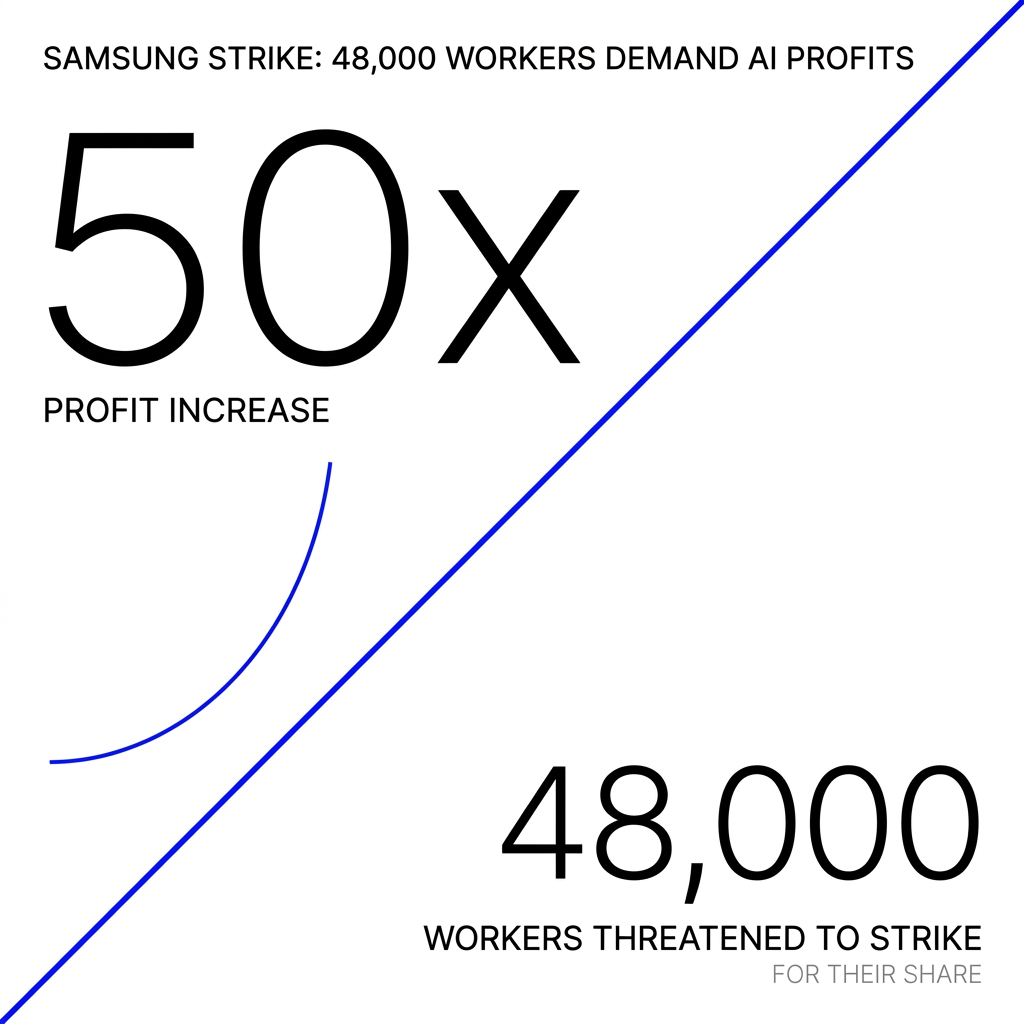
Samsung nearly faced the largest strike in its history earlier this year. Not over layoffs. Not over wages. Over who gets the money AI is making.
More than 48,000 workers—nearly 40% of Samsung's Korean workforce—threatened to walk out for 18 days. The reason? The company's memory chip division reported a nearly 50-fold rise in income driven by surging AI demand. Employees wanted their share.
They got it. Samsung settled with bonuses totaling approximately €350,000 per worker, with semiconductor employees receiving 10.5% of the company's operating earnings.
This wasn't a one-off labor dispute. This was the first major flashpoint over who owns the upside when AI drives productivity. And it won't be the last.
The Profit Explosion Nobody Planned For
AI isn't just changing how work gets done. It's changing how much money companies make from that work.
Total memory revenues jumped from $226 billion in 2025 to a projected $594.7 billion in 2026. That's not incremental growth. That's a structural shift in who captures value.
Samsung's memory chip workers saw this happening in real time. Their labor built the chips. AI demand made those chips wildly profitable. But the initial bonus proposal didn't reflect that reality.
Samsung offered its 27,000 memory chip workers bonuses equivalent to 607% of their annual salary. Sounds generous until you realize the company proposed giving 23,000 workers in logic chip and foundry businesses only 50% to 100% of salary.
Same buildings. Same company. Six times the difference.
That disparity exposed something uncomfortable: when AI generates asymmetric wealth inside organizations, traditional compensation models break down fast.
The Precedent Other Companies Are Watching
Samsung's settlement didn't happen in isolation. Competitor SK Hynix had already agreed to allocate 10% of annual operating profit directly to employees for the next decade. In 2026, that translated to average payouts between $460,000 and $477,000 per worker.
Now other Korean companies are facing similar demands. Employees at LG, Kakao, Hyundai Motor, and Kia are asking for AI-related bonuses tied to operating profit. Some are threatening strikes if their terms aren't met.
The pattern is clear: labor is claiming a percentage of AI-driven gains, not just asking for raises.
This isn't happening because workers oppose AI. It's happening because they see the productivity gains showing up in earnings reports but not in their compensation.
The AFL-CIO put it plainly: "AI has the potential to unleash prosperity that improves working conditions and lifts us all up. But if left unchecked in the hands of corporate profiteers, AI will increase economic inequality, curtail our rights and undermine our democracy."
Translation: labor isn't anti-technology. It's pro-equity in technology gains.
The Contradiction Companies Are Creating
Here's where the tension gets sharper.
By the end of 2026, 54% of companies will have cut employee compensation to fund AI efforts. Another 26% will have laid off workers for the same reason. Meanwhile, 92% of companies say AI investment is a higher priority than employee satisfaction.
Read that again. Companies are cutting worker pay to fund the technology that's generating record profits.
That's not a sustainable strategy. That's a recipe for labor unrest.
Employees aren't blind to the math. They see AI productivity gains flowing to shareholders while their compensation stagnates or shrinks. They see earnings calls celebrating AI-driven margins while their teams get smaller and their workloads grow.
Samsung's near-strike wasn't about rejecting AI. It was about rejecting the idea that only capital should benefit when AI works.
What This Means for Your Business
You don't need to run a semiconductor company to feel this coming.
If your business uses AI to increase output, reduce costs, or improve margins, your employees will eventually ask the same question Samsung's workers asked: where's our share?
The answer you give matters. Not just for morale, but for your ability to attract and retain talent in an AI-driven economy.
Consider what's already shifting:
Collective bargaining is evolving. The International Alliance of Theatrical Stage Employees now includes principles ensuring "the fruits of increased productivity through AI are shared equitably among all stakeholders." Unions aren't negotiating wages in isolation anymore. They're negotiating AI profit-sharing.
Policy is catching up. California Governor Gavin Newsom floated the idea of "universal basic capital"—a policy where workers own a piece of technology disruption. The concept could take several forms: mandatory equity grants for displaced workers, state-level capital pools funded by taxes on AI gains, or voluntary corporate profit-sharing with tax incentives.
Compensation models are being questioned. Traditional salary structures assume labor contributes a fixed percentage of value. AI breaks that assumption. When a single engineer's work gets amplified 10x or 100x by AI tools, how do you price that contribution? When AI automates entire workflows, who owns the resulting margin expansion?
These aren't hypothetical questions. They're showing up in boardrooms, HR meetings, and union negotiations right now.
The Position You Need Before Employees Force One
Samsung had to settle during a strike threat. That's not the position you want to be in.
Better to develop a clear stance before your employees organize around one. Here's what that looks like in practice:
Acknowledge the productivity shift. If AI is making your business more profitable, say so. Employees already know. Pretending otherwise erodes trust.
Define how gains get shared. You don't need to copy SK Hynix's 10% model, but you need a model. Will you tie bonuses to AI-driven performance? Offer equity? Create profit-sharing pools? The specifics matter less than having a transparent answer.
Differentiate between displacement and augmentation. If AI replaces jobs, that's one conversation. If AI amplifies existing roles, that's another. Be clear about which scenario applies to your business and what it means for compensation.
Involve employees early. Samsung's mistake wasn't the initial offer. It was making the offer without input from the people who built the chips. When workers feel excluded from decisions about AI-driven value, they organize. When they feel included, they collaborate.
Prepare for the long game. This isn't a one-time negotiation. AI adoption will continue reshaping how value gets created and captured. Your position today needs room to evolve as that technology matures.
The Real Risk Isn't the Technology
AI will keep driving productivity gains. That's not in question.
The question is whether those gains create shared prosperity or concentrated wealth. Samsung's near-strike proved that employees won't passively accept the latter.
The companies that navigate this well will treat AI profit-sharing as a strategic priority, not a reactive concession. They'll build compensation models that reflect the new economics of AI-amplified work. They'll engage employees in defining what fairness looks like when machines multiply output.
The companies that don't will face strikes, talent flight, and reputational damage.
You have time to get ahead of this. But not much. Samsung's workers gave their leadership 18 days. Your employees might give you less.
The question isn't whether AI will reshape labor economics. It already has. The question is whether you'll shape your company's response or wait for your employees to shape it for you.
Start now. Define your position. Communicate it clearly. Because the conversation about who owns AI's upside is happening whether you're ready or not.




No comments:
Post a Comment