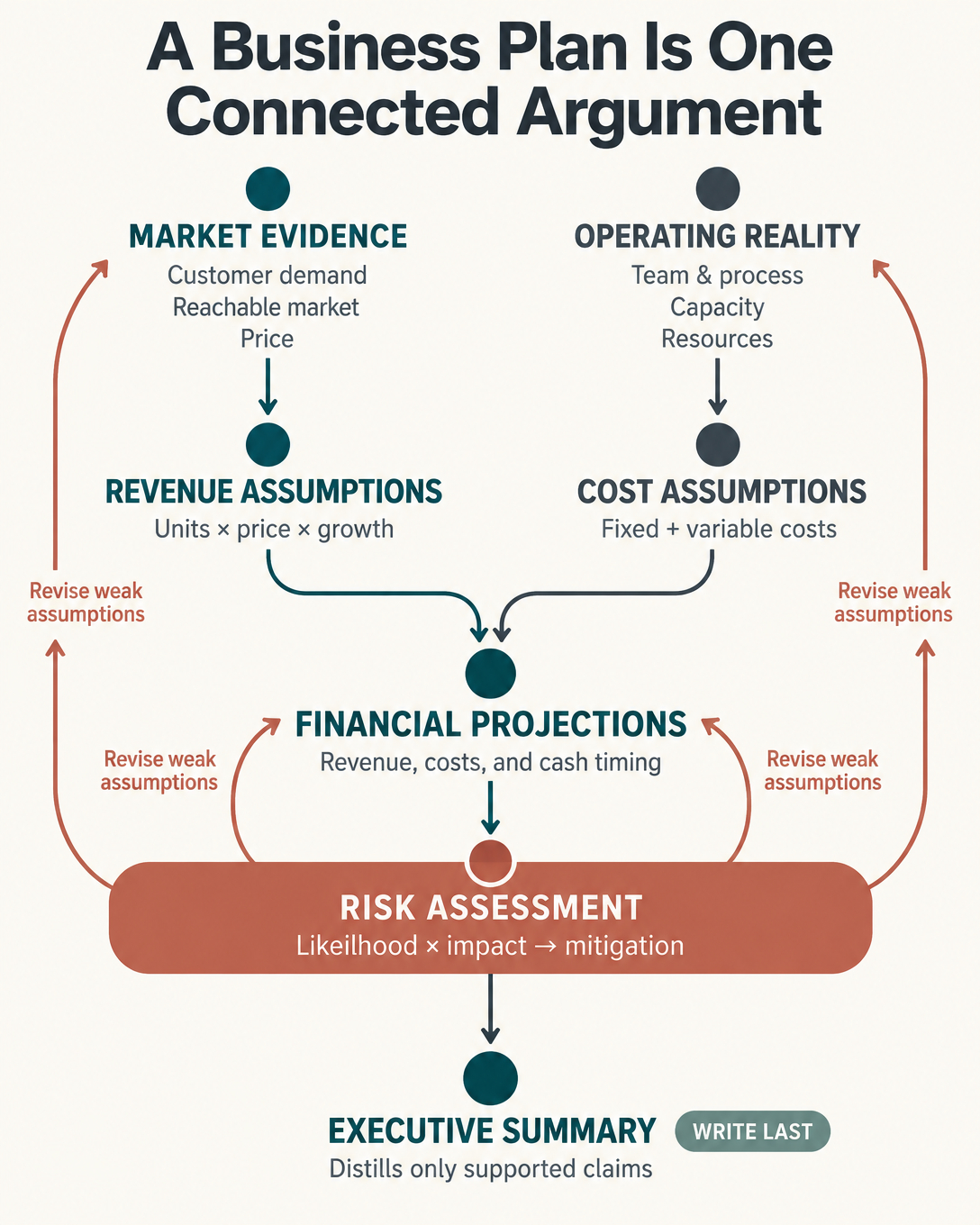
A professionally prepared business plan reads like one connected argument. Every section supports the others, and a weakness in one area shows up as a crack somewhere else.
This is worth stating early because it changes how you approach the outline. A template you fill in overnight produces five disconnected essays. A real plan produces one layered, interconnected document where the market analysis explains the financial projections, the operational structure explains the cost base, and the risk assessment ties everything back to reality.
This walkthrough covers the five core components in the order a reviewer encounters them: executive summary, market analysis, operational structure, financial projections, and risk assessment. For each one, you will see what the section does, why it matters, and how it connects to the rest of the plan.
Why the Outline Matters Before the Writing
The outline is where the thinking happens. Writing a business plan forces you to examine every part of the enterprise in detail, and that examination reveals strengths and vulnerabilities before they cost you money.
Treat the outline as a stress test for the business concept itself. When you sketch the five sections side by side, you see immediately whether your revenue assumptions match your market size, whether your team can deliver what your strategy promises, and whether your risks have answers.
This step is commonly overlooked. Founders often jump straight into writing the executive summary because it comes first in the document. Write it last. It summarizes work you have not done yet.
💡 Tip: Draft each section as a set of claims first. Then check whether the claims in one section contradict the claims in another. Contradictions found at the outline stage cost you an afternoon. Contradictions found by an investor cost you the meeting.
1. The Executive Summary: One Page That Carries the Whole Plan
The executive summary condenses the entire plan into one to two pages. It states what the business does, who it serves, how it makes money, what it needs, and why the team can deliver.
Its job is simple: earn the reader's attention for the rest of the document. Many reviewers read only this page before deciding whether to continue. That makes it the highest-stakes section per word.
What a Strong Summary Includes
The problem you solve and the customer who has it
The solution and what makes it viable
The market opportunity in one or two concrete sentences
The business model and how revenue flows
The team and why it fits this problem
The financial headline and any funding request
Every claim here must trace back to a fuller section later in the plan. A summary that promises numbers the financial section does not support undermines the credibility of the entire document. That connection is the first example of the layering principle at work.
2. Market Analysis: The Evidence Layer
The market analysis proves that demand exists. It defines your target customers, sizes the opportunity, maps the competition, and identifies the trends shaping the space.
This section carries the burden of proof for everything downstream. Your financial projections rest on the customer counts and price points you establish here. Your operational plan responds to the competitive pressures you identify here. Skip the homework in this section and the rest of the plan floats on assumptions.
Structure the Analysis in Four Parts
Industry overview. Define the sector, its size, and its direction. Ground each figure in a named, verifiable source.
Target market. Describe your specific customer segments, their needs, and their buying behavior. Specificity signals rigor.
Competitive landscape. Name your competitors, describe what they do well, and explain where you fit. A plan that claims no competition tells the reader the research stopped early.
Positioning. State the price, quality, and service position you will occupy and the reason customers will choose you.
⚠️ Warning: Most first drafts overestimate the reachable market. Distinguish the total market from the segment you can realistically serve in your first two years. Reviewers check this immediately.
3. Operational Structure: How the Business Actually Runs
The operational section describes how you deliver the product or service day to day. It covers your legal structure, team, location, suppliers, production or delivery process, and the technology that supports the work.
This section answers the feasibility question. The market analysis showed demand exists. Operations shows you can meet it at the quality and volume your projections assume.
Cover These Elements
Legal and organizational structure. Entity type, ownership, and governance.
Management team. Key people, their roles, and the experience that qualifies them.
Delivery process. The steps from raw input to paying customer, including suppliers and key partners.
Capacity. The volume you can handle now and the plan for scaling when demand grows.
Key resources. Facilities, equipment, software, and any licenses or certifications required.
The connection to finance is direct. Every operational choice creates a line item. Staff decisions become salary costs. Facility choices become rent. Supplier terms become working capital needs. When you outline this section, you are drafting the expense side of your financial projections at the same time.
4. Financial Projections: The Plan Translated Into Numbers
Financial projections express the entire plan in a common language. This section typically includes a revenue forecast, a projected income statement, a cash flow projection, and a balance sheet, usually covering three to five years.
Reviewers spend more time here than anywhere else, and they read the numbers as a test of the earlier sections. Revenue must follow from the market analysis. Costs must follow from the operational structure. A number without a source elsewhere in the plan reads as guesswork.
Build the Projections in This Order
Revenue model. Units, prices, and customer growth, drawn directly from your market section.
Cost structure. Fixed and variable costs, drawn directly from your operations section.
Cash flow. The timing of money in and out. Profitable businesses fail when cash runs out, so this statement deserves the most scrutiny.
Assumptions page. A plain list of every assumption behind the numbers. This page builds more trust than optimistic figures ever will.
A useful discipline: for every number in the projections, you should be able to point to the sentence earlier in the plan that justifies it.
💡 Tip: Prepare a conservative case alongside your base case. Showing the business survives a slow start demonstrates that you have thought past the best-case scenario.
5. Risk Assessment: The Section That Builds the Most Trust
The risk assessment identifies what can go wrong and states your response. It covers market risks, operational risks, financial risks, and regulatory or competitive threats.
Founders often treat this section as an admission of weakness. Experienced readers treat it as evidence of competence. A plan that names its risks and answers them signals that the founder has examined the business honestly.
A Practical Format
List your five to eight most significant risks.
Rate each one by likelihood and impact.
State a specific mitigation for each, tied to the operational or financial sections where the response lives.
The risk section also feeds back into everything before it. A serious supply risk should reshape your operational plan. A pricing risk should appear in your conservative financial case. When the risk assessment changes earlier sections, the document is doing its job. The plan becomes stronger through that friction, and sometimes the process reveals an opportunity or a needed pivot you had missed entirely.
The Plan Is a System, Treat It Like One
Here is the core insight worth carrying into your own outline. The five sections form a loop.
The market analysis justifies the revenue. Operations justify the costs. The projections combine both. The risk assessment stress tests all three. The executive summary distills the result. Change any one section and the change ripples through the others.
This is why a template filled in overnight fails. Each section can look complete on its own while the connections between them stay unexamined. The value of the plan sits in those connections.
One more point deserves emphasis. The finished document serves investors, and it serves you first. A well-built plan works as a living roadmap for your own decisions and a reference point that aligns your team on strategy, priorities, and the risks you have agreed to watch. Founders who revisit and revise the plan quarterly get far more from it than founders who write it once for a funding round and file it away.
Your Next Step
Start with the outline, using the sequence in this article. Draft the market analysis and operations sections first, since they generate the raw material for the numbers. Build the projections from those inputs. Run the risk assessment against everything. Write the executive summary last.
Expect the process to take weeks of honest work. That time is the point. Every contradiction you resolve on paper is a mistake you avoid in the market, and the discipline of connecting each section to the others produces something far more valuable than a document. It produces a founder who understands the business completely.
If you want a professionally developed business plan without navigating the process alone, Essential Business can help. Visit www.essentialbusiness.biz to get started.