Tuesday, January 27, 2026

How to Choose Startup Advisors Who Actually Move Your Business Forward

Test Gadget Preview Image

You need help. Your startup has gaps you can see clearly or maybe it's fundraising, maybe it's sales, maybe it's navigating regulations you've never dealt with before.

The question is who you bring in to fill those gaps.

Most founders approach advisor selection the wrong way. They chase impressive credentials or bring on people who sound smart in one conversation. Then months pass with no real contribution, and you realize you've wasted valuable time and money on relationships that go nowhere.

Here's what the data shows: 92% of small business owners report that mentorship has a significant impact on their business success and longevity. The difference between that 92% and the founders who waste time and resources comes down to how you select and structure the relationship.

Start With Your Actual Gaps

Before you talk to anyone, map what you don't know.

First-time founders typically need more advisors than experienced founders because the knowledge gaps are wider. But don't accumulate advisors for the sake of appearances. The goal is quality over quantity.

Ask yourself these questions:

What decisions am I avoiding because I lack expertise?

What conversations do I need to have that I can't access on my own?

What mistakes could kill this business that I wouldn't see coming?

Your answers point to the type of advisor you need. Advisors fall into distinct categories, each serving different purposes in your business.

Essential Professional Advisors

Before you think about strategic advisors, make sure you have the foundational professionals every business needs.

Accountant

A good accountant does more than file your taxes. They help you understand your numbers, set up proper financial systems, and identify tax strategies that save you money. Most small businesses should have an accountant involved from day one, even if it's just quarterly check-ins.

Look for an accountant who works with businesses at your stage and in your industry. They should explain financial concepts in plain language and be proactive about catching issues before they become problems.

Expect to pay $150 to $400 per hour for a qualified accountant, or $200 to $500 monthly for basic bookkeeping and financial review services.

Lawyer

You need legal counsel for business formation, contracts, employment agreements, and regulatory compliance. The right lawyer prevents costly mistakes and protects you when disputes arise.

Find a business attorney who understands your industry and can scale with you. Early on, you might only need them for specific transactions. As you grow, they become more involved in negotiations, intellectual property protection, and risk management.

Business attorneys typically charge $250 to $500 per hour depending on location and expertise. Some offer flat fees for standard services like LLC formation or contract review.

Bookkeeper

A bookkeeper manages day-to-day financial transactions—recording income and expenses, reconciling accounts, and maintaining accurate records. This frees you to focus on running the business instead of chasing receipts.

Many small businesses start by doing their own bookkeeping, then hire a part-time bookkeeper as transaction volume increases. The right time to bring one on is when you're spending more than a few hours per week on financial admin.

Bookkeepers charge $30 to $80 per hour, or $200 to $800 monthly for regular services depending on transaction volume and complexity.

These three professionals form your advisory foundation. They're not optional—they're essential infrastructure that protects your business and keeps you compliant. Once you have them in place, you can think about strategic advisors who help you grow.

Strategic Advisors

Strategic advisors are different from your professional service providers. They bring specific expertise or networks that help you solve growth challenges and avoid strategic mistakes. These relationships are more flexible and customized to your unique gaps.

Subject-Matter Experts

These people bring specialized knowledge your founding team lacks. If you're a technical founder building a B2B product, you might need someone with enterprise sales experience. If you're entering a regulated industry, you need someone who has navigated compliance before.

Subject-matter experts help you avoid expensive mistakes and compress your learning curve.

Industry Veterans

These people bring networks and credibility. They can facilitate key investor introductions and unlock opportunities that would otherwise stay closed. A single introduction from the right person can change your trajectory.

The value of industry veterans is in their willingness to make introductions and open doors. But that only matters if they actually use their network on your behalf.

How to Compensate Strategic Advisors

Unlike your accountant or lawyer who work on standard fee structures, strategic advisors require more flexible compensation arrangements that align payment with value delivered.

Common compensation structures include:

Hourly consulting fees: Pay for specific calls or project work. This works well when you need targeted expertise on an as-needed basis.

Monthly retainers: A fixed monthly fee for ongoing access and regular check-ins. Typical retainers range from $500 to $3,000 per month depending on experience and time commitment.

Project-based fees: A one-time payment for helping you solve a specific problem, like entering a new market or building a sales process.

Revenue sharing: A small percentage of revenue generated from opportunities the advisor directly facilitates. This aligns incentives and limits upfront cost.

Reciprocal relationships: Trading expertise with another founder or professional who needs what you offer. This works particularly well in the early stages.

The key is matching the compensation structure to the value you're receiving and what you can afford. Don't commit to ongoing payments unless you're confident the advisor will deliver ongoing value.

What Good Advisors Actually Do

Advisors provide value through five key areas:

Strategic feedback: Quarterly or monthly calls where they challenge your assumptions and help you think through major decisions.

Ad hoc expertise: On-demand consulting when you hit a specific problem in their domain.

Key introductions: Connections to investors, talent, customers, or partners you couldn't reach otherwise.

Product feedback: Perspective from someone who has seen what works and what fails in your market.

Brand ambassadorship: Public support that adds credibility when you're still building reputation.

The advisory relationship should have clear expectations and specific deliverables documented in writing. A simple written agreement outlining scope, time commitment, compensation, and deliverables prevents misunderstandings down the road.

The Most Common Mistake

The biggest error founders make is paying for "in name only" advisors.

You bring on impressive credentials without actual engagement, hoping it adds legitimacy. But when those advisors don't contribute, you've wasted money and lost valuable time you could have spent building real relationships.

83% of respondents believe advisors add value to their businesses, while 17% consider them a waste of time and money. The difference comes down to proper selection and structure.

Quality advisors give you access to 10,000 hours of experience without learning through expensive trial and error. They provide shortcuts to success and help you avoid costly mistakes. But only if they actually show up.

How to Evaluate Potential Advisors

Before you make an offer, test the relationship.

Ask for a few informal conversations first. See if they respond to your emails. Notice whether they ask good questions or just give generic advice.

Good advisors want to understand your specific situation before offering solutions. They ask about your customers, your unit economics, your team dynamics. They reference similar situations they've seen and explain what worked and what didn't.

Bad advisors speak in generalities and try to impress you with their resume.

Pay attention to their availability. If someone is too busy to meet before you formalize the relationship, they'll be too busy after.

Structure for Success

Once you identify the right person, structure the relationship for measurable contributions.

Set a regular meeting cadence. Monthly calls work for most advisory relationships. Quarterly calls work if the advisor is more strategic than tactical.

Define specific deliverables. Maybe it's three customer introductions in the first six months. Maybe it's reviewing your sales strategy before a major campaign. Maybe it's being available for ad hoc questions with a 48-hour response time.

Document everything in writing. A simple agreement covering scope, deliverables, payment terms, and duration protects both parties and sets clear expectations.

Review the relationship every six months. If an advisor isn't delivering value, have an honest conversation. Sometimes the fit changes as your business evolves, and it's better to end the arrangement than continue paying for diminishing returns.

When You Don't Need Advisors

Not every startup needs advisors.

If you're a repeat founder with deep industry experience, you might have the knowledge and network already. If you're resource-constrained and moving carefully, you might prefer to learn gradually rather than commit to formal advisory relationships.

Advisors make sense when the cost of mistakes exceeds the cost of the relationship. If you're entering a new market, raising venture capital for the first time, or building in a regulated space, the right advisor can save you months and prevent expensive errors.

But if you're just looking for validation or want to add impressive names to your website, skip it. That's a waste of money that won't move your business forward.

Bottom Line

The right advisors fill critical gaps in your knowledge and network. They help you make better decisions faster and avoid mistakes that could kill your business.

The wrong advisors waste time and money while creating the illusion of progress without actual results.

The difference comes down to how you select them, what you ask them to do, and how you structure the relationship. Start with your actual gaps, find people who have solved those specific problems, and create clear expectations from day one.

Your time and resources are valuable. Invest them in people who will actually move your business forward.


Thursday, January 22, 2026

When Your Biggest Customer Becomes Your Biggest Risk

Test Gadget Preview Image

I've been watching the 2025 US-Canada trade war unfold, and it tells a story every business owner needs to hear.

Canada sends 77% of its exports to the United States. That's three-quarters of an entire country's export economy depending on a single customer.

When President Trump announced 25% tariffs on Canadian imports in February 2025, Canada's economy contracted 0.4% in Q2. The export volume decline was the largest since 2009, excluding COVID-19.

This is customer concentration risk playing out at a national scale.

The 8% Rule You Need to Know

Financial experts recommend that no single customer should represent more than 8% of your total annual revenue.

If one customer exceeds this threshold, you have a concentration problem.

The math is simple. When a customer accounts for a large share of your revenue, they gain enormous leverage. They can disrupt your cash flow by paying late. They can demand price reductions. They can make increasing demands on your resources.

And when they leave, the damage can be fatal.

The 30% Failure Rate

Studies show that approximately 30% of small businesses collapse after losing one of their top clients.

I've seen this pattern repeat. A company builds its business around two or three major accounts. Revenue looks strong. Growth seems steady. Then one client switches to a competitor, and suddenly the business faces a 40% revenue drop.

The company cuts operations. Delays investment. Scrambles to replace the lost revenue.

Most don't recover.

How Concentration Kills Innovation

Research shows that a one-standard-deviation increase in customer concentration results in a 22.2% decrease in corporate risk-taking.

When you depend on a few large customers, you adopt precautionary measures. You avoid innovation that might upset key accounts. You become less competitive over time.

This creates a vicious cycle. Your concentrated customer base makes you more vulnerable. Your fear of losing those customers makes you less innovative. Your lack of innovation makes you easier to replace.

The Valuation Haircut

High customer concentration can result in 20-40% valuation haircuts from investors and acquirers.

They view concentrated businesses as higher risk. And they're right.

Customer concentration becomes serious when a single customer accounts for more than 10% of revenue, or when your top five customers contribute more than 25% of total revenue.

If you're planning to sell your business or raise capital, this matters.

Canada's Diversification Attempt

As trade tensions escalated in 2025, Canada tried to diversify away from US dependence.

Exports to Europe increased 22%. Exports to Africa rose 18%. Exports to Central and South America grew 11% compared to 2024.

But Canada has only recovered 25-30% of lost US export volume through alternative markets.

The lesson here is clear. Diversification takes time. You can't build new customer relationships overnight. By the time you realize you need them, it's often too late.

What This Means for Your Business

Nine in ten Canadian manufacturers that export to the US now plan to seek alternative customers outside the United States over the next 12 months.

They learned this lesson the hard way.

You don't have to.

Start tracking your customer concentration today. Calculate what percentage of your revenue comes from your largest customer. Then your top three. Then your top five.

If any single customer exceeds 8% of revenue, you have work to do.

If your top five customers exceed 25% of revenue, you're in the danger zone.

Building a Diversified Customer Base

Customer diversification mitigates business risk. But it requires intentional effort.

You need to actively pursue new customer segments. Explore different geographic markets. Develop products or services that appeal to a broader range of buyers.

This isn't about turning down large customers. It's about ensuring that no single relationship can destroy your business.

The best time to diversify is when you don't need to. When your major customers are happy. When revenue is strong. When you have the resources to invest in new relationships.

Because when you need to diversify, it's usually too late.

The Power Imbalance

When a single customer knows they're essential to your survival, the relationship changes.

They have leverage. You don't.

I've watched companies accept unfavorable terms, lower prices, and unreasonable demands because they couldn't afford to lose a major account.

That's not a partnership. That's dependency.

And dependency in business is dangerous.

What You Can Do Now

Start by measuring your customer concentration. The numbers don't lie.

Then set targets. If your largest customer represents 30% of revenue, aim to reduce that to 15% over the next 18 months. Not by losing that customer, but by growing revenue from other sources.

Invest in marketing to reach new customer segments. Develop relationships with smaller accounts that have growth potential. Consider new distribution channels or geographic markets.

Track your progress monthly. Customer concentration should be a key metric in your business dashboard, right alongside revenue and profit.

The Bottom Line

Canada's trade dependency on the US demonstrates what happens when you put too many eggs in one basket.

A 77% concentration on a single trading partner left an entire country vulnerable to policy changes beyond its control.

Your business faces the same risk on a smaller scale.

The solution is straightforward. Measure your customer concentration. Set targets to reduce it. Invest in diversification before you need it.

Because the time to build new customer relationships is when you don't desperately need them.

The businesses that survive long term are the ones that spread their risk. They build diverse customer bases. They avoid dependency on any single relationship.

They understand that your biggest customer can quickly become your biggest risk.

Don't wait for a crisis to learn this lesson.

Why AI Won't Save Your Business (And What Will)

Test Gadget Preview Image

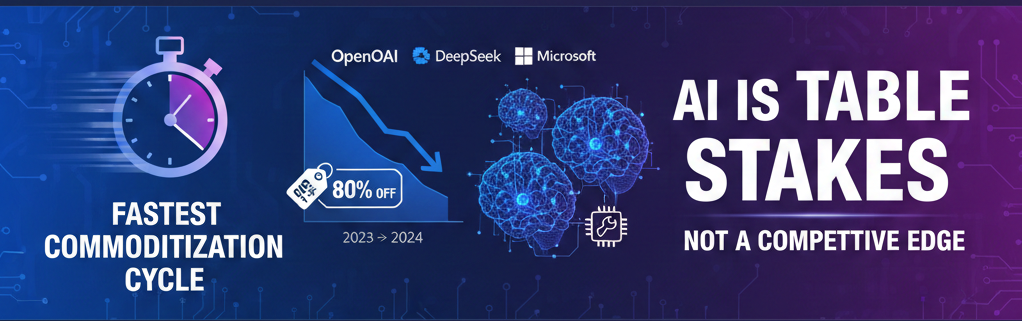
We're watching the fastest technology commoditization cycle in history.

OpenAI's token pricing dropped over 80% from 2023 to 2024. DeepSeek built a competitive AI model on a modest budget. Microsoft CEO Satya Nadella admits that foundational models are becoming so similar that "models by themselves are not sufficient" for lasting advantage.

The message is clear: AI is becoming table stakes, not a competitive edge.

This matters because 78% of organizations used AI in 2024, up from 55% the year before. When four out of five companies deploy the same technology, it stops being an advantage. It becomes the cost of doing business.

The Pattern We've Seen Before

Personal computers transformed business in the 1980s. Early adopters gained efficiency and speed advantages that seemed insurmountable.

Then everyone bought computers.

The internet followed the same path. Companies that built websites first enjoyed visibility and reach their competitors envied. Within years, not having a website became the liability.

AI is following this exact trajectory, just faster.

The lifecycle from innovation to commodity used to take years. Now it takes months. Some markets move from nascent to commodity almost overnight. Consumer generative AI commoditized immediately upon release.

OpenAI board chair Bret Taylor calls this "the fastest technology commoditization cycle we've ever seen." The barriers to AI entry are collapsing at unprecedented speed.

Why Widespread Access Eliminates Advantage

MIT Sloan Management Review published a rigorous analysis applying classic resource-based view theory to AI. Their conclusion: artificial intelligence does not change the fundamental nature of sustained competitive advantage when its use is pervasive.

The logic is straightforward.

For resources to provide sustainable competitive advantage, they must be valuable, rare, hard to imitate, and embedded within your organization. This framework comes from Jay Barney's established business theory.

AI fails three of these four criteria.

It's valuable. Everyone agrees on that. But it's increasingly neither rare, hard to imitate, nor non-substitutable. Open-source models reliably erode corporate offerings. Hardware competition intensifies. Talent is plentiful.

A company with valuable and rare resources can achieve temporary competitive advantage. But the resource must also be costly to imitate if you want sustained advantage.

AI clearly doesn't meet these criteria.

Once AI use becomes ubiquitous, it will transform economies and lift markets as a whole. But it won't uniquely benefit any single company. The technology's transformative power doesn't guarantee competitive advantage.

What Actually Creates Lasting Differentiation

The real differentiator will be what AI models don't have access to: private knowledge bases and industry-specific insights.

Companies that build domain-specific solutions or layer proprietary data onto commoditized models will have the edge. Your unique data, relationships, and insights matter more than the AI itself.

Consider Insilico Medicine. They developed the world's first generative AI-designed drug in just 18 months for $2.6 million. Traditional drug development takes six years and costs $400 million.

The AI democratized what used to be an advantage. Now the differentiator is the proprietary research data and domain expertise that guides the AI.

Nadella emphasized this point when he said OpenAI "is not a model company; it's a product company that happens to have fantastic models." True advantage comes from what you build around the technology.

The Strategic Shift You Need to Make

Early AI adopters will see temporary gains. But those gains evaporate as competitors adopt the same tools.

The window for AI-based advantage is closing faster than any technology in business history.

This creates three immediate implications for your strategy:

First, stop treating AI adoption as your competitive strategy. It's infrastructure. You need it to compete, but having it won't make you win. Focus your strategic energy on the capabilities AI enables, not the technology itself.

Second, invest in proprietary data and unique organizational knowledge. The companies that win will have better inputs, not better models. Your customer insights, process innovations, and relationship networks become more valuable as AI becomes more common.

Third, prepare for a talent war around creativity and judgment. When everyone has access to the same analytical power, human creativity becomes the scarce resource. The ability to ask better questions, frame problems differently, and synthesize insights will command premium value.

What This Means for Your Next Five Years

We're entering a period where human capital and organizational capabilities will matter more than ever.

AI will raise baseline productivity across entire industries. Companies that couldn't afford certain capabilities will suddenly have access. Small teams will accomplish what used to require large departments.

This creates market consolidation pressure. When AI democratizes capabilities, the differentiator shifts to execution speed, customer relationships, and brand trust.

Education and workforce development will transform. The skills that matter will shift from technical execution to strategic thinking, creative problem-solving, and relationship building.

Customer expectations will rise universally. When every company can provide AI-powered service, the bar for acceptable performance moves up. What seems impressive today becomes expected tomorrow.

The innovation paradox will intensify. As AI makes iteration faster and cheaper, the volume of new products and services will explode. Standing out becomes harder even as creating becomes easier.

The Bottom Line

AI won't provide sustainable competitive advantage because it's becoming universally accessible.

The technology will transform how we work. It will boost productivity and streamline processes. It will change entire industries.

But transformation and advantage are different things.

Your competitive edge will come from what you do with AI, not from having it. The companies that win will combine commoditized AI with proprietary data, unique insights, and exceptional human judgment.

They'll build cultures that ask better questions. They'll develop relationships that AI can't replicate. They'll create organizational knowledge that takes years to accumulate.

The race isn't to adopt AI first. The race is to build the capabilities that matter when everyone has AI.

Start building those capabilities now. The window is shorter than you think.

Saturday, January 17, 2026

What a "Closing for Renovations" Sign Taught Me About Leadership

Test Gadget Preview Image

I was sitting in the barber's chair last week when I noticed the sign.

"Closed for renovations: 10 days in January."

I asked my stylist what they were doing to the space. She paused, scissors mid-air.

"I don't know. They haven't told us."

That moment stuck with me. Here was a business about to shut down for nearly two weeks, and the people who work there every day had no idea what was happening.

The Questions That Multiply in Silence

My business experience and MBA kicked in immediately. I started thinking about what was probably running through her mind.

Where will my chair be when we reopen? Are they adding stations or removing them? Will my clients appreciate the changes? What if the new layout doesn't work for how I do my job?

These aren't small concerns. For someone who earns their living in that space, uncertainty about a 10-day closure becomes anxiety about their livelihood.

The research backs this up. A study published in the Journal of Contingency and Crisis Management found that organizations prioritizing open communication reduce employee anger from 24% to just 5%. When employees experience transparent communication during change, anxiety levels drop from 51% to 29%, and hopefulness toward change increases from 17% to 35%.

But here's the part that really matters: workplace pride rises from 27% to 59% when people feel informed.

Why Leaders Stay Silent

I've thought about this owner's perspective too. They probably have reasons for keeping the renovation plans close.

Maybe they're worried the staff won't like the changes. Maybe they think it's easier to present a finished product than manage reactions to plans. Maybe they genuinely believe a 10-day closure doesn't warrant a big discussion.

The data tells a different story. According to Oak Engage's 2023 Change Report, 41% of employees resist organizational change because they lack trust in leadership. Another 39% cite lack of awareness about why change is happening. 38% fear the unknown.

The silence doesn't protect anyone. It creates the exact problems leaders hope to avoid.

The Real Cost of Information Vacuums

Research on workplace stress reveals that half of American workers affected by organizational changes report higher chronic work stress. They're less likely to trust their employer and more likely to leave within the next year.

Think about that. A simple renovation becomes a trust issue. A physical upgrade to the space becomes an emotional downgrade in the relationship between owner and staff.

When communication channels are opaque, employees struggle to access important information. This leads to misunderstandings, missed opportunities, and a lack of alignment with organizational goals.

In this case, the stylist doesn't know if she should be excited or worried. She can't plan. She can't prepare. She just waits.

From Informed to Invested

Here's what the research shows about transparent communication during organizational change: it encourages problem-focused coping, reduces uncertainty, and fosters stronger employee-organization relationships.

When employees receive comprehensive information including both positive and negative news, it reduces anxiety toward uncertainty.

More importantly, it changes how people engage with change.

A comprehensive employee survey of 727 participants identified transparent communication and employee engagement as key mediators between authentic leadership and individual behavioral outcomes.

Translation: when you tell people what's happening, they perform better.

Employee engagement research shows that organizations with high employee engagement driven by transparent communication are four times more likely to succeed than organizations with higher rates of disengagement.

What Ownership Actually Means

If I were that owner, I would have done things differently. I would have discussed the renovation plans with at least the senior staff to get their impressions and thoughts.

The owner always has the final say. But having that discussion with the staff is always positive unless the relationship is already broken. And if the relationship is broken, you have bigger problems than renovations.

Involving staff makes them feel like they have input and take ownership. The staff feels like there is value in what they have to say. The ownership sees that the staff care about what is happening.

This mutual recognition matters. Talent acquisition research shows that companies that divulge information transparently have a huge competitive advantage when it comes to attracting job seekers and retaining employees.

Studies on organizational transparency demonstrate that transparent organizations see employee engagement increase by up to 40%. In environments where interdependence between departments is high, that engagement directly impacts quality outcomes.

The Innovation Dividend

Transparent leadership builds the foundation for a secure environment where risk-taking and problem-solving thrive.

In today's climate where companies need to innovate continuously to stay competitive, fostering trust through transparency is imperative for long-term success.

Transparency also contributes to better problem-solving and innovation. Employees are more likely to voice their ideas and concerns when they feel informed and valued.

According to Salesforce research, when employees feel their voice is heard at work, they are 4.6 times more likely to perform their best work.

That barber shop could have tapped into the collective wisdom of people who work in that space every day. They could have learned about workflow issues, customer preferences, or practical concerns that only become obvious when you're actually doing the work.

Instead, they chose silence.

What This Means for You

If you're leading any kind of change in your organization, even something as straightforward as a renovation, ask yourself these questions:

Who needs to know about this? Not who deserves to know, but who will be affected by it.

What are they probably worried about? Put yourself in their position and think through the questions that will keep them up at night.

When should you tell them? Earlier than feels comfortable. Before rumors start. Before anxiety builds.

How much should you share? More than you think. Include the reasoning, the timeline, and what you don't know yet.

The goal isn't to get everyone's approval. The goal is to treat people like adults who have a stake in the outcome.

Because they do.

The Competitive Advantage Hidden in Plain Sight

According to Deloitte's 2024 Global Human Capital Trends study, 86% of leaders directly correlate transparency to workforce trust.

Harvard Business Review research reveals that employees in high-trust workplaces experience 74% less stress, 50% higher productivity, and 40% less burnout.

These aren't soft metrics. These are the numbers that determine whether your business thrives or struggles.

That barber shop owner probably thinks the renovation is about updating the space. But the real renovation needed is in how they communicate with their team.

The physical changes will be visible in 10 days. The trust issues might take years to repair.

Or they could start now by having a conversation.

The Data Behind Dismantling Hierarchies: Why Flat Organizations Win

Test Gadget Preview Image

I've been watching a quiet revolution unfold in how companies organize themselves. The traditional pyramid structure is cracking under its own weight.

The numbers tell a story that many leaders still refuse to hear.

The Innovation Tax of Hierarchy

Companies with flat organizational structures enjoy a 25% higher likelihood of being leaders in innovation compared to traditional hierarchies. Meanwhile, 62% of employees report feeling constrained by rigid hierarchies, leading to a 30% decline in overall innovation productivity.

This isn't about theory. This is measurable business impact.

Harvard Business Review research identifies "authority bias" as perhaps the most significant cultural barrier stifling innovation. We overvalue opinions from the top and undervalue opinions from the bottom. This eventually turns into exaggerated deference to the chain of command.

The problem is obvious when you look at where innovation actually comes from. Much of the know-how required for innovation comes from the bottom of the organization. Yet many non-management employees consider innovation outside the scope of their jobs.

We've built systems that actively suppress the very people who could drive us forward.

Speed Matters More Than You Think

A study of more than 300 executives found that the greater the number of layers in an organization, the slower the speed by which new products and services reached customers.

Teams with less hierarchy display a 40% higher probability of generating groundbreaking ideas.

Speed isn't just about moving fast. It's about survival. When your competitors can make decisions in days while you're stuck in weeks of approval chains, you're already losing.

Flat organizations respond to market changes with remarkable agility. Decisions can be made more quickly with fewer layers of management, allowing organizations to rapidly respond to changes in the market or competitive landscape.

Companies with less than three layers of management experience a 60% increase in innovation outputs, according to Deloitte.

The Autonomy Advantage

Employees who have the opportunity to choose when and where they work are 2.3 times more likely to give their best performance compared to those with less autonomy. These same employees are also 2.3 times more likely to stay at an organization.

Workers who feel valued deliver 17% higher overall productivity and demonstrate measurable improvements in product quality.

This data challenges everything we've been taught about control and management. The tighter you grip, the less you get.

Autonomy isn't about letting people do whatever they want. It's about trusting them to solve problems in ways you haven't thought of yet.

Servant Leadership Delivers Results

Recent 2024-2025 research confirms that servant leadership positively impacts employee performance through enhanced organizational trust and employee voice. A study of 375 telecom employees found that servant leadership significantly improves performance by building organizational trust as a mediating factor.

The concept is simple. Prioritize the well-being and needs of employees before expecting performance.

This isn't soft management. This is strategic management backed by data.

Research on vocational schools showed that employees led by principals embodying servant leadership principles demonstrate higher performance levels, contributing to sustainable work environments.

When you focus on helping people grow, they focus on helping the business grow. The relationship is direct.

The Real Cost of Hierarchies

Hierarchies can restrict creativity, innovation, and the ability of leaders to motivate employees due to rigid structures that hinder adaptability.

Employees in flat organizations exhibit higher engagement, motivation, and commitment. They feel less like cogs in a machine and more like valued contributors.

The shift demonstrates that productivity isn't tied to location but to clear goals, supportive systems, and employee autonomy.

Companies implementing flexible work policies and wellness programs report 20% lower burnout rates and sustained high productivity in the long run.

Recent workplace studies reveal that 91% of employees globally prefer working remotely full-time or most of the time. This emphasizes flexibility as essential for retention and engagement.

What This Means for Your Organization

You can't fix a structural problem with cultural initiatives. If your hierarchy is blocking innovation, no amount of "innovation workshops" will solve it.

The data points to three clear actions:

Reduce management layers. Every layer you remove increases speed and innovation output. Start by mapping decision flows and identifying bottlenecks.

Increase employee autonomy. Give people control over when and how they work. Measure outcomes, not hours. Trust the people you hired to do their jobs.

Adopt servant leadership principles. Focus on removing obstacles for your team rather than directing their every move. Your job is to enable their success.

The Human Element

Behind every data point is a person who either feels valued or doesn't. Who either has a voice or stays silent. Who either brings their best ideas to work or keeps them to themselves.

Flat organizations work because they align with how humans actually function. We perform better when we have autonomy. We innovate more when we're not afraid of the chain of command. We stay longer when we feel valued.

The research on work-life balance and flexibility shows that respecting employees' time isn't a perk. It's a strategic imperative. Companies that treat time as a resource to be controlled rather than respected pay the price in turnover and disengagement.

The Path Forward

Leadership is evolving from a science of control to an approach focused on human flourishing. The companies that understand this will attract better talent, move faster, and innovate more effectively.

The companies that don't will keep wondering why their best people leave and their competitors keep winning.

Eliminating management layers unlocks significant energy and innovation within an organization. The data proves it. The question is whether you're willing to act on it.

Future leadership will foster innovation, collaboration, and ethical decision-making. It will integrate positive practices and psychological safety. It will prioritize follower well-being and relationship-building.

This isn't a trend. This is the direction business is moving, driven by data and demanded by the workforce.

Final Thought

The call to respect employees' time reflects a broader trend toward valuing work-life balance and recognizing the importance of employee well-being. This shift moves us away from purely transactional employer-employee relationships toward more holistic and human-centered approaches.

The numbers don't lie. Flat organizations generate 25% higher innovation leadership. Employees with autonomy perform 2.3 times better. Servant leadership improves performance through organizational trust.

You can keep your hierarchy and watch your best people leave for companies that trust them. Or you can look at the data and make the hard decisions that lead to better outcomes.

The choice has always been yours. Now you have the evidence to make it.

Monday, January 12, 2026

Why Banks Still Can't Fund Startups in 2026

Test Gadget Preview Image

Banks rejected 80% of small business loan applications in 2024.

For startups, the numbers get worse. Only 32% of SBA loan applicants received full approval. The rest got denied or received partial funding that couldn't support their growth plans.

The problem isn't that banks lack capital. The problem is that banks still evaluate startups using risk models built for a different era.

The 2019 Risk Model Problem

Traditional bank risk assessment relies on three core metrics: historical financial performance, tangible collateral, and consistent cash flow.

These metrics work well for established businesses. A restaurant with five years of steady revenue and owned real estate fits the model perfectly. Banks can predict default risk with reasonable accuracy.

Startups break this model completely.

A software company with no revenue, no physical assets, and negative cash flow for three years looks identical to a failing business in traditional risk frameworks. The model can't distinguish between a pre-revenue startup building toward a $50 million exit and a struggling company heading toward bankruptcy.

Banks categorize startups alongside restaurants and businesses with bad credit in their "high-risk" bucket. The classification happens automatically because the historical data points don't exist.

How Traditional Models Fail Innovation

The 2008 financial crisis exposed how traditional risk models collapse when faced with complex, interconnected risks. Banks relied on historical data and linear assumptions that couldn't account for rapid market changes.

Startups present the same challenge today.

Traditional models depend on manual analysis and structured historical data. This approach is slow and works poorly in rapidly changing environments. Companies using only traditional methods are 20-30% less likely to achieve strong revenue growth compared to those incorporating modern risk assessment approaches.

The problem compounds when you look at how banks actually use their credit scoring systems. Research from the Federal Reserve found that 70% of credit exposures cluster within just two grades in a 10-grade system. This lack of granularity means genuinely promising startups get lumped together with high-risk ventures.

Senior management at banks question the "resolution power" of their own credit rating systems. The models can't differentiate between different types of risk.

Alternative Financing Options

When traditional bank financing isn't available, startups have several paths forward—each with distinct advantages and trade-offs.

Venture capital offers substantial funding and strategic connections but requires giving up significant equity and accepting pressure for rapid, scalable growth. Angel investors provide more flexible terms and mentorship, though typically at smaller amounts. Crowdfunding validates market demand while building a customer base, but demands intensive marketing effort and public exposure of your business model.

Bootstrapping preserves complete ownership and control, yet limits growth speed and puts personal finances at risk. Revenue-based financing ties repayment to actual sales without diluting equity, though it can become expensive for high-margin businesses. Government grants and programs offer non-dilutive capital, but involve lengthy application processes and restrictive usage requirements.

Each option works differently depending on your business model, growth timeline, and personal goals. We'll explore the specific mechanics, requirements, and strategies for each financing path in future posts.

The Real Cost of Outdated Models

Nearly 30% of startup failures trace back to lack of funding. This makes it one of the top reasons new businesses don't survive.

The funding gap forces founders into difficult choices. They can bootstrap and grow slowly, potentially missing market windows. They can pursue venture capital and give up significant equity early. Or they can abandon viable business ideas entirely.

Banks face their own costs. They miss opportunities to build relationships with high-growth companies. By the time a startup succeeds and needs traditional banking services, they've already established relationships with other financial institutions.

The disconnect creates massive inefficiency in capital allocation. Banks have capital to deploy. Startups need capital to grow. But the risk assessment infrastructure can't connect the two effectively.

What Needs to Change

Banks need risk models that can evaluate forward-looking metrics.

This means incorporating data on market size, competitive positioning, team experience, and customer acquisition trends. It means understanding that negative cash flow in year two can signal healthy growth rather than impending failure.

Some banks are making progress. Specialized lenders have developed hybrid models that combine traditional risk assessment with venture-style evaluation. These institutions can serve startups while managing risk appropriately.

But most banks continue using frameworks designed for established businesses. Their systems flag startups as high-risk automatically, regardless of actual business quality or growth potential.

The technology exists to build better models. Real-time monitoring and predictive analysis can assess startup risk more accurately than historical-data-only approaches. Financial institutions that adopt these tools gain competitive advantages in serving high-growth companies.

The Path Forward

The startup funding landscape will continue shifting toward alternative capital sources until traditional banks update their risk frameworks.

This creates opportunities for financial institutions willing to invest in modern risk assessment capabilities. Banks that can evaluate startups effectively will access a growing market of high-potential businesses.

For startups, understanding why banks reject them helps set realistic expectations. The rejection often reflects model limitations rather than business quality. Founders can focus their efforts on funding sources designed to evaluate early-stage companies.

The gap between banking infrastructure and startup needs won't close quickly. Traditional institutions move slowly, especially when changing core risk management systems. But the pressure is building as venture capital continues capturing market share in business lending.

Banks that adapt their risk models to evaluate innovation effectively will gain first-mover advantages. Those that don't will watch the startup economy grow without them.

Can You Train Your Brain to Build Better Businesses?

Test Gadget Preview Image

Andrew Hammond's book "Entrepreneurship and Neuroscience: Researching Brain-Driven Entrepreneurship" makes a bold claim: understanding and enhancing specific brain functions can improve your chances of entrepreneurial success.

The premise sounds appealing. Use EEG technology and cognitive training to measure and improve focus, creativity, resilience, and decision-making. Programs like the Technopreneurship Summer School have already started testing these methods.

But does the science actually support this approach?

The Mental Health Case for Brain Training

Entrepreneurs face mental health challenges at twice the rate of non-entrepreneurs. 72% deal with anxiety, burnout, or stress compared to 48% of the general population.

These numbers reframe brain training from optional to essential. When you're operating under constant pressure, understanding your brain's operating system becomes survival equipment.

The question is whether neuroscience tools provide genuine help or just add another layer of complexity to an already difficult journey.

EEG as Objective Measurement

Traditional entrepreneurship assessment relies on interviews and questionnaires. You report how you feel, what you think, how you handle stress.

EEG goes deeper by measuring actual brain activity.

A University of Kobe study used EEG to detect the interplay between emotions and entrepreneurial decision-making. Researchers measured brain responses to emotionally charged words before participants made risk-based decisions.

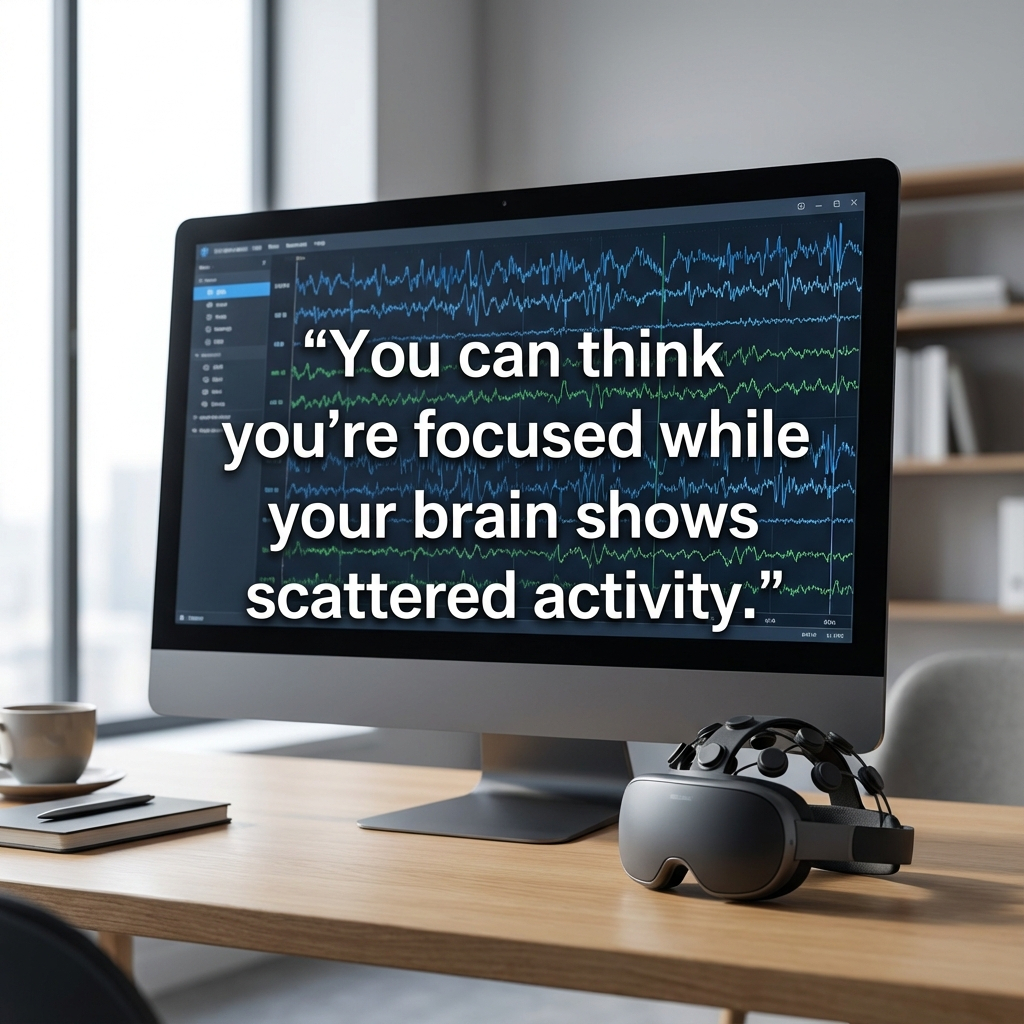
The advantage is objectivity. You can think you're focused while your brain shows scattered activity. You can believe you're handling pressure well while operating in a suboptimal cognitive state.

This matters because many entrepreneurs lack self-awareness about their actual mental state, especially under stress.

Ancient Practice Meets Modern Verification

Mindfulness training has existed for centuries. The new element is measurement.

Harvard research found that eight weeks of daily mindfulness sessions improved attention, memory, mood, and emotional regulation. Participants showed increased efficiency in brain pathways that process sensory information and better ability to focus on tasks while ignoring distractions.

The critical detail: these improvements were measured through EEG brain activity, not self-reported.

This validates what ancient teachings have long claimed while providing the objective data that business-minded people often require before investing time in practice.

The Evidence Gap

A systematic review analyzed 56 articles in neuroentrepreneurship published between 1999 and 2021. Most studies used neuroscience tools like EEG, fMRI, and eye tracking.

The conclusion was measured: "Much remains to be done to prove that this approach is as valuable as advertised."

The field acknowledges it needs more practical applications and independent replication. One researcher's findings need verification by multiple groups before you can confidently recommend the approach to aspiring entrepreneurs.

A September 2025 Nature Scientific Reports study found that entrepreneurs show different gray matter volume in brain regions associated with risk-taking. The study suggests these differences may reflect neuroplasticity from experience rather than innate traits.

This raises an important question: do certain brain patterns make you entrepreneurial, or does entrepreneurial experience shape your brain?

Real-World Application

Xi'an Jiaotong-Liverpool University's Technopreneurship Summer School represents one of the first practical applications. Students engaged in cognitive training exercises like maintaining focus on moving visual stimuli and building simple robot prototypes while reflecting on their mental processes.

This moves the concept from theory to classroom, but we still need data on whether participants who completed the training launched more successful businesses than those who didn't.

Traditional entrepreneurship education has reached a plateau. Despite countless programs, rates of entrepreneurial intention remain stagnant. This suggests we need new approaches, but we need proof that brain-based training delivers better results.

The Training Model

The most practical framework positions neuroscience tools as foundational preparation rather than constant monitoring.

You train with feedback during calm moments to build cognitive capacity. When real stress hits, you trust the capacity you've developed rather than relying on technology.

This aligns with ancient teachings that acknowledge elevated stress periods require trust in developed skills. Constant monitoring during high-pressure situations adds another layer of stress rather than helping you perform.

The model: train with EEG feedback to verify you're actually achieving focused mental states. Build that capacity over time. Then perform without monitoring when it matters.

The Guardrails Question

The limitations and ethical implications of neuroscience in entrepreneurship need consideration.

Successful leaders often excel because they take decisive action to overcome weaknesses through self-discipline while maintaining flexibility. Technology should inform your path, not determine it.

If an EEG assessment shows weak cognitive flexibility but strong focus, what specific training addresses that gap? How do you ensure the assessment becomes a tool for personalized development rather than a deterministic label?

These questions need answers before widespread adoption.

Where This Leaves You

The intersection of neuroscience and entrepreneurship shows promise but remains early-stage.

The case for objective measurement is strong. EEG can verify whether you're actually achieving the mental states you think you're in. This beats self-reporting for accuracy.

The connection to mindfulness and presence practices provides a bridge between ancient wisdom and modern verification. You can train these skills, and you can measure improvement.

But the field needs more independent studies showing that entrepreneurs who complete brain-based training launch more successful businesses than those who follow traditional paths.

Until that evidence exists, treat neuroscience tools as complementary to traditional business education rather than a replacement. Use them as diagnostic and training tools to understand your cognitive baseline and build capacity.

The science is real. The applications are emerging. The proof of long-term business impact is still developing.

With more information, you can make better decisions. Right now, the information suggests cautious optimism paired with healthy skepticism.

Wednesday, January 7, 2026

Your Face Is Being Scored Before You Say a Word

Test Gadget Preview Image

When you record a video interview from your living room, you assume someone will eventually watch it.

What you don't assume is that an algorithm is already analyzing your facial expressions, scoring your tone, and calculating whether your eyebrow movements suggest you're "leadership material."

But that's exactly what's happening.

More than 700 major companies now use AI-driven video interview platforms that assess candidates against databases containing up to 25,000 facial and vocal data points. Your interview score can be influenced by 350 linguistic elements—speech speed, sentence length, use of passive versus active words—and facial action units that account for up to 29% of your final rating.

You're being evaluated before the hiring manager even opens your file.

The Technology Behind the Curtain

HireVue, one of the largest AI interview platforms, has evaluated more than a million job seekers. Companies like Unilever, Delta, Hilton, Oracle, and IKEA use these systems to screen candidates at scale.

The appeal is obvious: efficiency. Instead of spending hours reviewing hundreds of video submissions, recruiters receive ranked lists with "employability scores" generated by AI.

The problem is equally obvious: these systems don't just evaluate what you say. They evaluate how you look when you say it.

In 2021, German journalists tested a popular AI interview platform and discovered something unsettling. Changing hairstyles, wearing different accessories, or adjusting the brightness of the video altered personality scores. Even having a bookshelf in the background versus a blank wall changed assessment results.

Your qualifications stayed the same. Your score didn't.

When Bias Gets Automated at Scale

The bias issues aren't hypothetical.

Research shows that 44% of AI video interview systems demonstrate gender bias, while 26% show both gender and race bias. A University of Washington study found that AI systems preferred white-associated names 85% of the time compared to Black-associated names just 9% of the time. The systems never favored Black male-associated names over white male-associated names.

The error rates tell the same story. For light-skinned men, the facial recognition error rate is 0.8%. For darker-skinned women, it jumps to 34.7%.

This isn't a minor glitch. When nine out of ten companies now use some form of AI in hiring, and 78% of large enterprises have integrated these tools into recruitment processes, we're talking about systematic exclusion at an unprecedented scale.

The technology that promised to remove human bias from hiring has simply encoded it in a different format.

The Automation Bias Problem

Here's where it gets more complicated.

University of Washington researchers found that when people worked alongside AI hiring systems, they mirrored the AI's biases. If the AI preferred non-white candidates, human reviewers did too. If it preferred white candidates, humans followed that pattern.

Even when the AI showed severe bias, people made only slightly less biased decisions than the system recommended.

This phenomenon—called automation bias—means we trust AI recommendations more than our own judgment. We assume the algorithm sees something we don't. We defer to the machine's assessment even when it conflicts with our own evaluation.

The result is that biased AI doesn't just influence hiring decisions. It amplifies them.

The Regulatory Response Is Beginning

After public backlash in 2021, HireVue discontinued its facial recognition feature. The Electronic Privacy Information Center filed a complaint with the Federal Trade Commission, urging investigation into "unfair and deceptive" practices.

New York City went further.

Since July 2023, employers in NYC must conduct independent bias audits on any AI tools used for hiring. Companies must provide public access to audit results. Candidates must be notified when AI systems will evaluate them. Violations carry penalties ranging from $375 to $1,500 per incident.

Local Law 144 requires annual bias audits and candidate notices before using automated employment decision tools.

It's a start. But New York City represents a fraction of the hiring landscape.

What This Means for You

If you're applying for jobs, you need to know this technology exists.

When a company asks you to record a video interview, assume an algorithm will analyze it before a human does. Pay attention to lighting, background, and yes—your facial expressions. Not because you're vain, but because these factors influence your score.

If you're hiring, you need to understand what your tools are actually doing.

Ask your vendors about bias audits. Request transparency about what factors influence candidate scores. Question whether facial analysis adds value or simply automates prejudice.

And if you're building or selling these systems, recognize that "efficient" and "fair" aren't the same thing.

The Broader Question

The debate about AI in hiring isn't really about technology.

It's about what we're willing to automate and what we're not. It's about whether we trust algorithms to assess human potential based on facial movements and vocal patterns. It's about who gets left out when we prioritize speed over scrutiny.

Facial features have always influenced hiring decisions. Unconscious bias has always existed. What's different now is the scale and the illusion of objectivity.

When a human interviewer makes a biased decision, we can challenge it. When an algorithm generates a score, it feels scientific. Final. Beyond question.

But the algorithm is just math applied to assumptions. And if those assumptions are flawed, the math doesn't fix them. It just makes them harder to see.

Your face is being scored. The question is whether we're comfortable with who's doing the scoring and what they're measuring.

Video: https://youtu.be/7cmYclkOdEs

Friday, January 2, 2026

Seven Social Media Shifts That Will Redefine Your Strategy by 2026

Test Gadget Preview Image

The platforms you use every day are changing how they work.

Instagram now lets you control what the algorithm shows you. TikTok is becoming a search engine. YouTube is pushing long-form content again. Facebook wants you to complete purchases without leaving the app.

These aren't minor updates. They represent a fundamental shift in how platforms generate revenue, how audiences consume content, and how brands need to show up.

If you're still optimizing for 2023's playbook, you're already behind.

On-Platform Conversion Is Replacing Traffic Arbitrage

Social platforms are building complete sales environments inside their apps.

Shopify reported that luxury brand SIMKHAI increased conversion rates by 84% and lowered cost per acquisition by 54% using Instagram's native commerce tools. Eighty-nine percent of their new customers came through social audiences who never left the platform.

This mirrors Facebook's lead form strategy from years ago. Keep users on-site, serve more ads, generate more revenue.

Social commerce sales will represent over 17% of total online sales in 2025. By 2026, global social commerce is projected to hit $2.9 trillion.

The platforms that win are the ones that keep users inside their ecosystem longest. That means brands driving traffic to external websites are fighting against platform incentives.

Your conversion strategy needs to work where your audience already is.

Algorithm Control Is Shifting to Users

Instagram launched its "Tune Your Algorithm" feature in December 2025.

Users can now add or remove entire topic categories from their Reels and Explore feeds. You can explicitly tell Instagram you don't want to see fitness content, cooking videos, or business advice.

This changes everything about content distribution.

Creators can no longer rely on algorithmic momentum to carry mediocre content. If your audience doesn't actively want what you're making, they'll remove your category entirely.

The shift moves social media from passive consumption to active curation. Users are taking control of their feeds, which means you need to deliver consistent value that audiences intentionally seek.

Algorithmic luck is dying. Intentional value is replacing it.

Long-Form Content Is Making a Comeback

The short-form content gold rush is cooling.

While 85% of marketers still believe short-form videos are most effective, the data tells a different story. Long-form videos between 30-60 minutes achieve the highest conversion rates when paired with lead generation features.

Educational content in this length sees engagement rates of 26%. Production of long-form videos increased by 446% over five years, compared to just 100% for content under one minute.

YouTube reports that 51% of users are most likely to engage with brand videos longer than 60 seconds. TikTok now supports 10-minute uploads. Instagram is testing longer Reels.

Audiences are craving depth over dopamine hits.

Serialized, narrative-driven content is proving more effective at retaining attention than rapid-fire clips. The platforms are responding by accommodating longer formats.

If you've been chopping everything into 15-second segments, you're leaving engagement on the table.

Social Platforms Are Becoming Search Engines

A 2024 Adobe study found that 64% of Gen Z respondents in the United States have used TikTok as a search engine.

Nearly 10% of Gen Z prefer TikTok over Google for information searches. Google's own internal research shows that almost 40% of young people ages 18-24 use TikTok or Instagram instead of Google Maps or Search when looking for lunch spots.

Platforms are indexing captions, hashtags, audio, and on-screen text. They're transforming into full-fledged search engines with visual results.

This means every post you publish needs SEO optimization. Your captions need to answer questions. Your content needs to provide solutions people are actively searching for.

If your content isn't discoverable through search, it won't exist in six months.

The shift also creates long-tail visibility opportunities. A well-optimized video from 2024 can drive traffic in 2026 if it answers the right question.

Expertise Is Overtaking Entertainment

The influencer marketing model is fracturing.

Video tutorials are the top content choice for 62% of TikTok users. Thirty-nine percent favor reviews, and 38% prefer personal anecdotes from real people.

Audiences want expertise and authentic experience over generic influencer content. Among Gen Z TikTok users, 40% are captivated by content tailored to their specific interests.

Brands are shifting budgets toward credible subject matter experts with genuine authority.

The average engagement rate for accounts with over 10 million followers on TikTok was 10.5%. Smaller creators achieved 9.74%. Audience size matters less than content substance.

Corporate partnerships are favoring educators and specialists. The future points toward co-branded products developed with experts, not simple endorsements from generic influencers.

If you're building a personal brand, your expertise is your competitive advantage. If you're hiring creators, look for depth over follower count.

Authenticity Is Non-Negotiable

Audiences are rejecting synthetic content.

Virtual influencers and AI personalities are failing to gain traction. Surveys show that the majority of brands have no plans to use virtual influencers due to low authenticity and poor engagement.

Genuine human connection is preferred over AI-generated content. This matters in an environment where AI tools make it easier than ever to produce volume.

Emotional authenticity is becoming a key competitive differentiator.

The brands winning attention are the ones showing real people, real processes, and real outcomes. Polished perfection is losing to honest documentation.

If your content feels manufactured, your audience will scroll past it.

Quality Is Replacing Volume

The typical internet user now spends about 2 hours and 30 minutes on social media each day. US users spend an average of 52 minutes daily watching social video content.

But there are early signs of content fatigue.

In 2023, 91% of consumers wanted to see more videos from brands. By 2025, that number dropped to 83%. That's an 8-percentage-point decline in two years.

Audiences are becoming more selective about content quality, not just volume.

Gen Z social media usage is plateauing. People are craving substantial, meaningful content over shallow posts. Retention-based tactics that viewers find insulting will cause you to lose audiences.

The focus is shifting toward nutrient-dense content rather than junk food content. If you're publishing seven times a day with nothing to say, you're training your audience to ignore you.

What This Means for Your Strategy

These shifts concentrate power within social media platforms. They control data, customer relationships, and revenue streams. Your dependency on platform ecosystems is increasing.

The traditional open web model is diminishing. Website ownership and independent online presence matter less when platforms become complete ecosystems.

The attention economy model is proving unsustainable. The emphasis on quality and long-form content signals a shift toward value creation over engagement farming.

The rise of expert authority is democratizing digital influence. Traditional marketing budgets are being disrupted by credible specialists who build audiences through genuine expertise.

Generational differences in information discovery are accelerating. Younger demographics favor social platforms over traditional search engines. Your SEO strategy needs to account for both.

Businesses optimizing for on-platform conversion face increased vulnerability to platform policy changes. Diversification matters more than ever.

How to Adapt

Start testing native commerce features on the platforms where your audience already engages. Measure conversion rates against your traditional funnel.

Optimize every post for search. Use clear, descriptive captions that answer questions your audience is asking.

Experiment with longer content formats. Test 5-minute videos against 30-second clips and measure completion rates.

Build genuine expertise in a specific domain. Document your process, share your failures, and show your work.

Focus on creating content that provides value people actively seek, not content that tricks the algorithm.

The platforms are changing the rules because the old model stopped working. Audiences are exhausted by volume and hungry for substance.

The brands and creators who win in 2026 will be the ones who adapt to these shifts early, not the ones who cling to tactics that worked in 2023.

Your strategy needs to evolve with the platforms, not against them.

Video: https://youtu.be/IUhyQThwDr0?si=__PFS0R_BziMhQkf


When Everyone Gets the Same Raise, Nobody Wins

I've been watching a quiet shift happen in corporate compensation. More companies are moving toward uniform pay increases across their e...