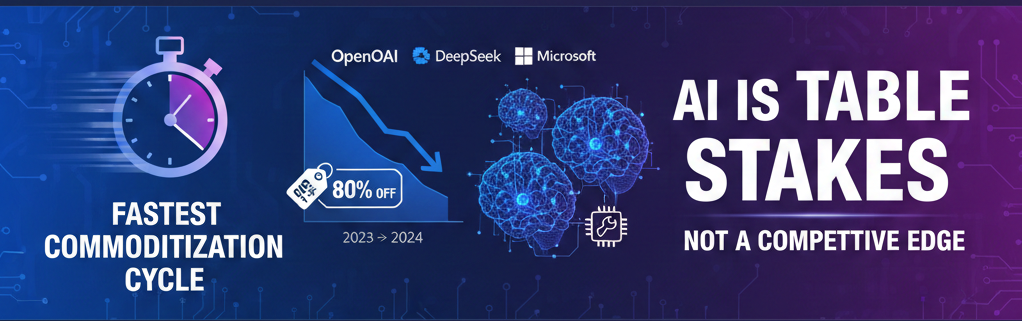
We're watching the fastest technology commoditization cycle in history.
OpenAI's token pricing dropped over 80% from 2023 to 2024. DeepSeek built a competitive AI model on a modest budget. Microsoft CEO Satya Nadella admits that foundational models are becoming so similar that "models by themselves are not sufficient" for lasting advantage.
The message is clear: AI is becoming table stakes, not a competitive edge.
This matters because 78% of organizations used AI in 2024, up from 55% the year before. When four out of five companies deploy the same technology, it stops being an advantage. It becomes the cost of doing business.
The Pattern We've Seen Before
Personal computers transformed business in the 1980s. Early adopters gained efficiency and speed advantages that seemed insurmountable.
Then everyone bought computers.
The internet followed the same path. Companies that built websites first enjoyed visibility and reach their competitors envied. Within years, not having a website became the liability.
AI is following this exact trajectory, just faster.
The lifecycle from innovation to commodity used to take years. Now it takes months. Some markets move from nascent to commodity almost overnight. Consumer generative AI commoditized immediately upon release.
OpenAI board chair Bret Taylor calls this "the fastest technology commoditization cycle we've ever seen." The barriers to AI entry are collapsing at unprecedented speed.
Why Widespread Access Eliminates Advantage
MIT Sloan Management Review published a rigorous analysis applying classic resource-based view theory to AI. Their conclusion: artificial intelligence does not change the fundamental nature of sustained competitive advantage when its use is pervasive.
The logic is straightforward.
For resources to provide sustainable competitive advantage, they must be valuable, rare, hard to imitate, and embedded within your organization. This framework comes from Jay Barney's established business theory.
AI fails three of these four criteria.
It's valuable. Everyone agrees on that. But it's increasingly neither rare, hard to imitate, nor non-substitutable. Open-source models reliably erode corporate offerings. Hardware competition intensifies. Talent is plentiful.
A company with valuable and rare resources can achieve temporary competitive advantage. But the resource must also be costly to imitate if you want sustained advantage.
AI clearly doesn't meet these criteria.
Once AI use becomes ubiquitous, it will transform economies and lift markets as a whole. But it won't uniquely benefit any single company. The technology's transformative power doesn't guarantee competitive advantage.
What Actually Creates Lasting Differentiation
The real differentiator will be what AI models don't have access to: private knowledge bases and industry-specific insights.
Companies that build domain-specific solutions or layer proprietary data onto commoditized models will have the edge. Your unique data, relationships, and insights matter more than the AI itself.
Consider Insilico Medicine. They developed the world's first generative AI-designed drug in just 18 months for $2.6 million. Traditional drug development takes six years and costs $400 million.
The AI democratized what used to be an advantage. Now the differentiator is the proprietary research data and domain expertise that guides the AI.
Nadella emphasized this point when he said OpenAI "is not a model company; it's a product company that happens to have fantastic models." True advantage comes from what you build around the technology.
The Strategic Shift You Need to Make
Early AI adopters will see temporary gains. But those gains evaporate as competitors adopt the same tools.
The window for AI-based advantage is closing faster than any technology in business history.
This creates three immediate implications for your strategy:
First, stop treating AI adoption as your competitive strategy. It's infrastructure. You need it to compete, but having it won't make you win. Focus your strategic energy on the capabilities AI enables, not the technology itself.
Second, invest in proprietary data and unique organizational knowledge. The companies that win will have better inputs, not better models. Your customer insights, process innovations, and relationship networks become more valuable as AI becomes more common.
Third, prepare for a talent war around creativity and judgment. When everyone has access to the same analytical power, human creativity becomes the scarce resource. The ability to ask better questions, frame problems differently, and synthesize insights will command premium value.
What This Means for Your Next Five Years
We're entering a period where human capital and organizational capabilities will matter more than ever.
AI will raise baseline productivity across entire industries. Companies that couldn't afford certain capabilities will suddenly have access. Small teams will accomplish what used to require large departments.
This creates market consolidation pressure. When AI democratizes capabilities, the differentiator shifts to execution speed, customer relationships, and brand trust.
Education and workforce development will transform. The skills that matter will shift from technical execution to strategic thinking, creative problem-solving, and relationship building.
Customer expectations will rise universally. When every company can provide AI-powered service, the bar for acceptable performance moves up. What seems impressive today becomes expected tomorrow.
The innovation paradox will intensify. As AI makes iteration faster and cheaper, the volume of new products and services will explode. Standing out becomes harder even as creating becomes easier.
The Bottom Line
AI won't provide sustainable competitive advantage because it's becoming universally accessible.
The technology will transform how we work. It will boost productivity and streamline processes. It will change entire industries.
But transformation and advantage are different things.
Your competitive edge will come from what you do with AI, not from having it. The companies that win will combine commoditized AI with proprietary data, unique insights, and exceptional human judgment.
They'll build cultures that ask better questions. They'll develop relationships that AI can't replicate. They'll create organizational knowledge that takes years to accumulate.
The race isn't to adopt AI first. The race is to build the capabilities that matter when everyone has AI.
Start building those capabilities now. The window is shorter than you think.


No comments:
Post a Comment