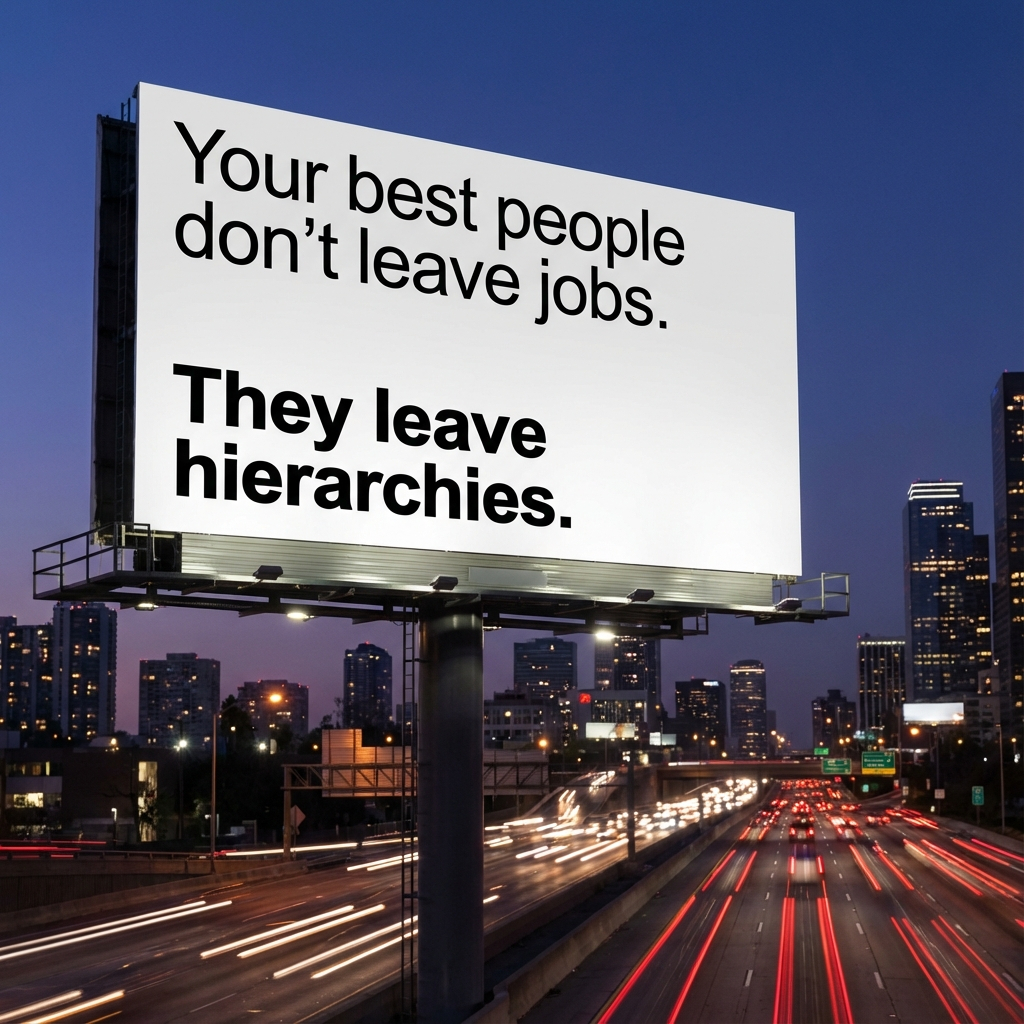
I've been watching a quiet revolution unfold in how companies organize themselves. The traditional pyramid structure is cracking under its own weight.
The numbers tell a story that many leaders still refuse to hear.
The Innovation Tax of Hierarchy
Companies with flat organizational structures enjoy a 25% higher likelihood of being leaders in innovation compared to traditional hierarchies. Meanwhile, 62% of employees report feeling constrained by rigid hierarchies, leading to a 30% decline in overall innovation productivity.
This isn't about theory. This is measurable business impact.
Harvard Business Review research identifies "authority bias" as perhaps the most significant cultural barrier stifling innovation. We overvalue opinions from the top and undervalue opinions from the bottom. This eventually turns into exaggerated deference to the chain of command.
The problem is obvious when you look at where innovation actually comes from. Much of the know-how required for innovation comes from the bottom of the organization. Yet many non-management employees consider innovation outside the scope of their jobs.
We've built systems that actively suppress the very people who could drive us forward.
Speed Matters More Than You Think
A study of more than 300 executives found that the greater the number of layers in an organization, the slower the speed by which new products and services reached customers.
Teams with less hierarchy display a 40% higher probability of generating groundbreaking ideas.
Speed isn't just about moving fast. It's about survival. When your competitors can make decisions in days while you're stuck in weeks of approval chains, you're already losing.
Flat organizations respond to market changes with remarkable agility. Decisions can be made more quickly with fewer layers of management, allowing organizations to rapidly respond to changes in the market or competitive landscape.
Companies with less than three layers of management experience a 60% increase in innovation outputs, according to Deloitte.
The Autonomy Advantage
Employees who have the opportunity to choose when and where they work are 2.3 times more likely to give their best performance compared to those with less autonomy. These same employees are also 2.3 times more likely to stay at an organization.
Workers who feel valued deliver 17% higher overall productivity and demonstrate measurable improvements in product quality.
This data challenges everything we've been taught about control and management. The tighter you grip, the less you get.
Autonomy isn't about letting people do whatever they want. It's about trusting them to solve problems in ways you haven't thought of yet.
Servant Leadership Delivers Results
Recent 2024-2025 research confirms that servant leadership positively impacts employee performance through enhanced organizational trust and employee voice. A study of 375 telecom employees found that servant leadership significantly improves performance by building organizational trust as a mediating factor.
The concept is simple. Prioritize the well-being and needs of employees before expecting performance.
This isn't soft management. This is strategic management backed by data.
Research on vocational schools showed that employees led by principals embodying servant leadership principles demonstrate higher performance levels, contributing to sustainable work environments.
When you focus on helping people grow, they focus on helping the business grow. The relationship is direct.
The Real Cost of Hierarchies
Hierarchies can restrict creativity, innovation, and the ability of leaders to motivate employees due to rigid structures that hinder adaptability.
Employees in flat organizations exhibit higher engagement, motivation, and commitment. They feel less like cogs in a machine and more like valued contributors.
The shift demonstrates that productivity isn't tied to location but to clear goals, supportive systems, and employee autonomy.
Companies implementing flexible work policies and wellness programs report 20% lower burnout rates and sustained high productivity in the long run.
Recent workplace studies reveal that 91% of employees globally prefer working remotely full-time or most of the time. This emphasizes flexibility as essential for retention and engagement.
What This Means for Your Organization
You can't fix a structural problem with cultural initiatives. If your hierarchy is blocking innovation, no amount of "innovation workshops" will solve it.
The data points to three clear actions:
Reduce management layers. Every layer you remove increases speed and innovation output. Start by mapping decision flows and identifying bottlenecks.
Increase employee autonomy. Give people control over when and how they work. Measure outcomes, not hours. Trust the people you hired to do their jobs.
Adopt servant leadership principles. Focus on removing obstacles for your team rather than directing their every move. Your job is to enable their success.
The Human Element
Behind every data point is a person who either feels valued or doesn't. Who either has a voice or stays silent. Who either brings their best ideas to work or keeps them to themselves.
Flat organizations work because they align with how humans actually function. We perform better when we have autonomy. We innovate more when we're not afraid of the chain of command. We stay longer when we feel valued.
The research on work-life balance and flexibility shows that respecting employees' time isn't a perk. It's a strategic imperative. Companies that treat time as a resource to be controlled rather than respected pay the price in turnover and disengagement.
The Path Forward
Leadership is evolving from a science of control to an approach focused on human flourishing. The companies that understand this will attract better talent, move faster, and innovate more effectively.
The companies that don't will keep wondering why their best people leave and their competitors keep winning.
Eliminating management layers unlocks significant energy and innovation within an organization. The data proves it. The question is whether you're willing to act on it.
Future leadership will foster innovation, collaboration, and ethical decision-making. It will integrate positive practices and psychological safety. It will prioritize follower well-being and relationship-building.
This isn't a trend. This is the direction business is moving, driven by data and demanded by the workforce.
Final Thought
The call to respect employees' time reflects a broader trend toward valuing work-life balance and recognizing the importance of employee well-being. This shift moves us away from purely transactional employer-employee relationships toward more holistic and human-centered approaches.
The numbers don't lie. Flat organizations generate 25% higher innovation leadership. Employees with autonomy perform 2.3 times better. Servant leadership improves performance through organizational trust.
You can keep your hierarchy and watch your best people leave for companies that trust them. Or you can look at the data and make the hard decisions that lead to better outcomes.
The choice has always been yours. Now you have the evidence to make it.


No comments:
Post a Comment