Andrew Hammond's book "Entrepreneurship and Neuroscience: Researching Brain-Driven Entrepreneurship" makes a bold claim: understanding and enhancing specific brain functions can improve your chances of entrepreneurial success.
The premise sounds appealing. Use EEG technology and cognitive training to measure and improve focus, creativity, resilience, and decision-making. Programs like the Technopreneurship Summer School have already started testing these methods.
But does the science actually support this approach?
The Mental Health Case for Brain Training
Entrepreneurs face mental health challenges at twice the rate of non-entrepreneurs. 72% deal with anxiety, burnout, or stress compared to 48% of the general population.
These numbers reframe brain training from optional to essential. When you're operating under constant pressure, understanding your brain's operating system becomes survival equipment.
The question is whether neuroscience tools provide genuine help or just add another layer of complexity to an already difficult journey.
EEG as Objective Measurement
Traditional entrepreneurship assessment relies on interviews and questionnaires. You report how you feel, what you think, how you handle stress.
EEG goes deeper by measuring actual brain activity.
A University of Kobe study used EEG to detect the interplay between emotions and entrepreneurial decision-making. Researchers measured brain responses to emotionally charged words before participants made risk-based decisions.
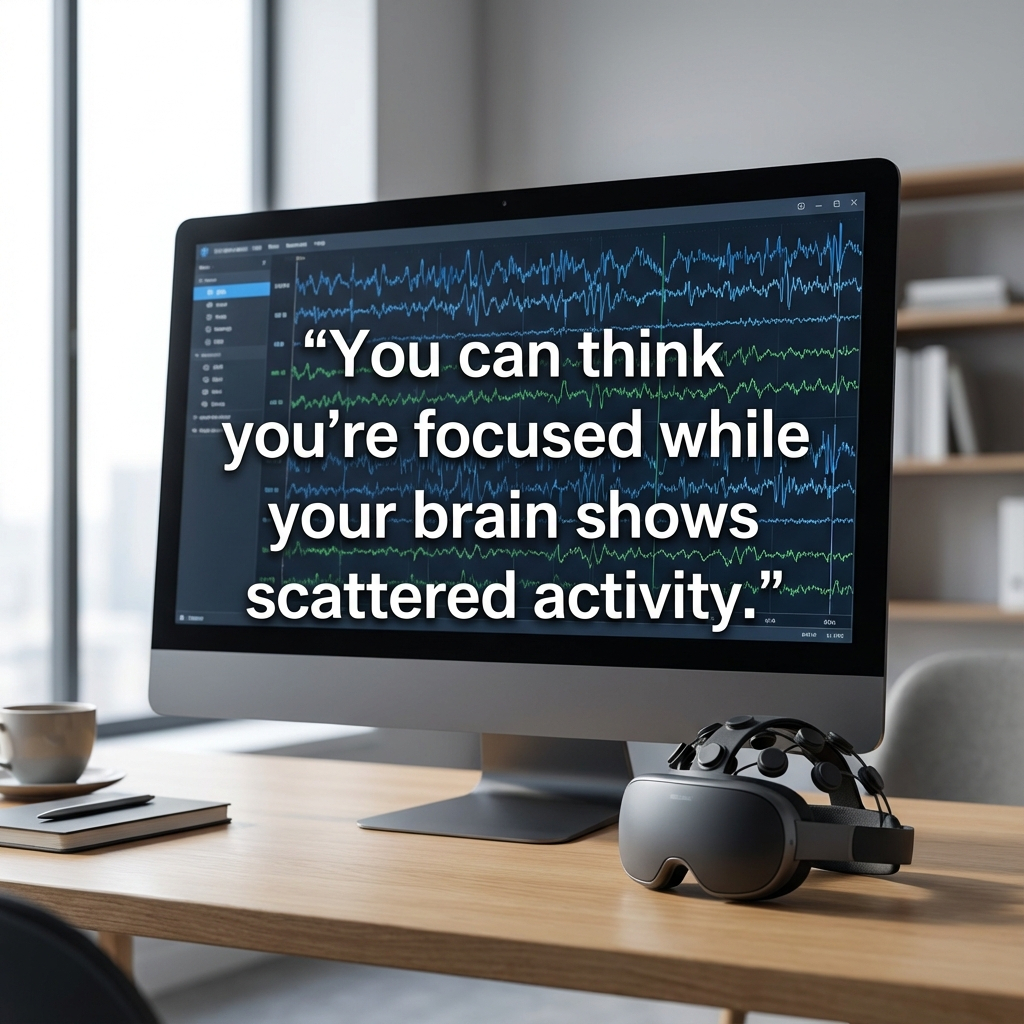
The advantage is objectivity. You can think you're focused while your brain shows scattered activity. You can believe you're handling pressure well while operating in a suboptimal cognitive state.
This matters because many entrepreneurs lack self-awareness about their actual mental state, especially under stress.
Ancient Practice Meets Modern Verification
Mindfulness training has existed for centuries. The new element is measurement.
Harvard research found that eight weeks of daily mindfulness sessions improved attention, memory, mood, and emotional regulation. Participants showed increased efficiency in brain pathways that process sensory information and better ability to focus on tasks while ignoring distractions.
The critical detail: these improvements were measured through EEG brain activity, not self-reported.
This validates what ancient teachings have long claimed while providing the objective data that business-minded people often require before investing time in practice.
The Evidence Gap
A systematic review analyzed 56 articles in neuroentrepreneurship published between 1999 and 2021. Most studies used neuroscience tools like EEG, fMRI, and eye tracking.
The conclusion was measured: "Much remains to be done to prove that this approach is as valuable as advertised."
The field acknowledges it needs more practical applications and independent replication. One researcher's findings need verification by multiple groups before you can confidently recommend the approach to aspiring entrepreneurs.
A September 2025 Nature Scientific Reports study found that entrepreneurs show different gray matter volume in brain regions associated with risk-taking. The study suggests these differences may reflect neuroplasticity from experience rather than innate traits.
This raises an important question: do certain brain patterns make you entrepreneurial, or does entrepreneurial experience shape your brain?
Real-World Application
Xi'an Jiaotong-Liverpool University's Technopreneurship Summer School represents one of the first practical applications. Students engaged in cognitive training exercises like maintaining focus on moving visual stimuli and building simple robot prototypes while reflecting on their mental processes.
This moves the concept from theory to classroom, but we still need data on whether participants who completed the training launched more successful businesses than those who didn't.
Traditional entrepreneurship education has reached a plateau. Despite countless programs, rates of entrepreneurial intention remain stagnant. This suggests we need new approaches, but we need proof that brain-based training delivers better results.
The Training Model
The most practical framework positions neuroscience tools as foundational preparation rather than constant monitoring.
You train with feedback during calm moments to build cognitive capacity. When real stress hits, you trust the capacity you've developed rather than relying on technology.
This aligns with ancient teachings that acknowledge elevated stress periods require trust in developed skills. Constant monitoring during high-pressure situations adds another layer of stress rather than helping you perform.
The model: train with EEG feedback to verify you're actually achieving focused mental states. Build that capacity over time. Then perform without monitoring when it matters.
The Guardrails Question
The limitations and ethical implications of neuroscience in entrepreneurship need consideration.
Successful leaders often excel because they take decisive action to overcome weaknesses through self-discipline while maintaining flexibility. Technology should inform your path, not determine it.
If an EEG assessment shows weak cognitive flexibility but strong focus, what specific training addresses that gap? How do you ensure the assessment becomes a tool for personalized development rather than a deterministic label?
These questions need answers before widespread adoption.
Where This Leaves You
The intersection of neuroscience and entrepreneurship shows promise but remains early-stage.
The case for objective measurement is strong. EEG can verify whether you're actually achieving the mental states you think you're in. This beats self-reporting for accuracy.
The connection to mindfulness and presence practices provides a bridge between ancient wisdom and modern verification. You can train these skills, and you can measure improvement.
But the field needs more independent studies showing that entrepreneurs who complete brain-based training launch more successful businesses than those who follow traditional paths.
Until that evidence exists, treat neuroscience tools as complementary to traditional business education rather than a replacement. Use them as diagnostic and training tools to understand your cognitive baseline and build capacity.
The science is real. The applications are emerging. The proof of long-term business impact is still developing.
With more information, you can make better decisions. Right now, the information suggests cautious optimism paired with healthy skepticism.




No comments:
Post a Comment