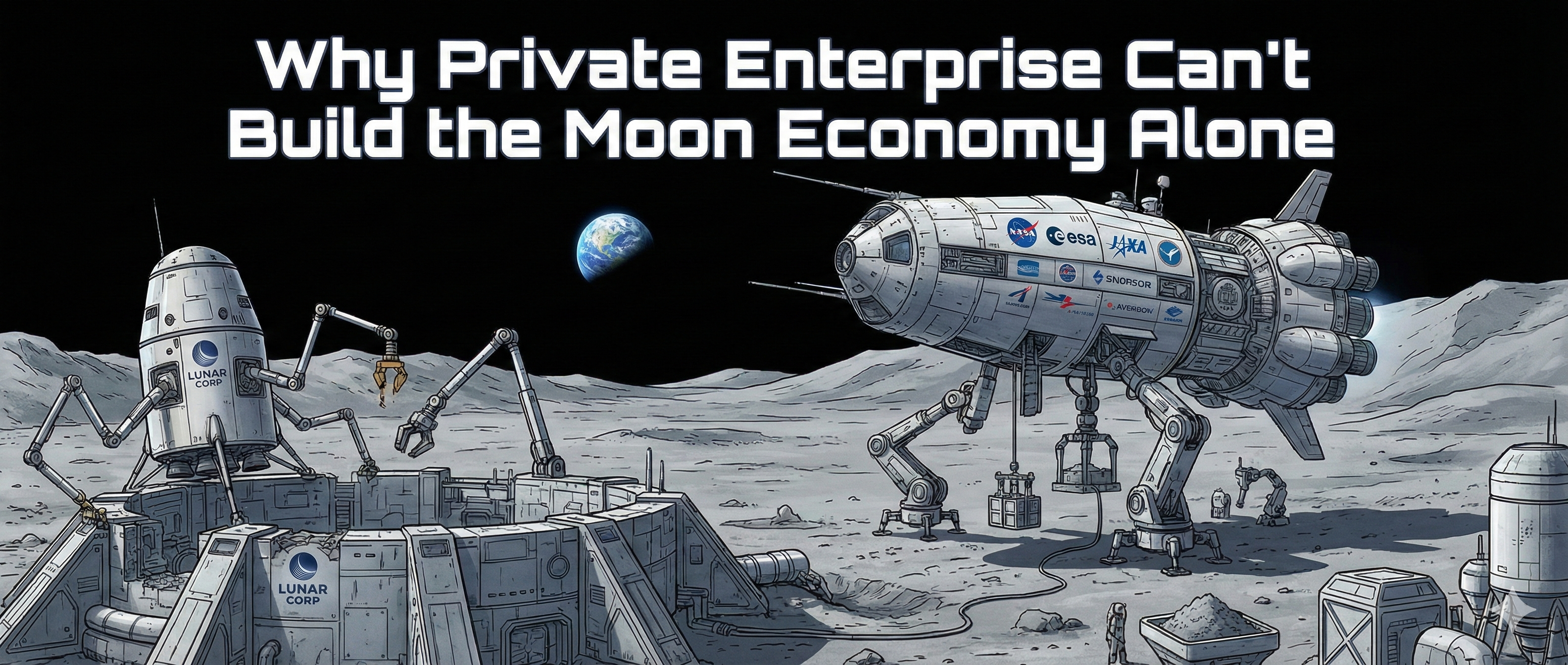
I've been studying how NASA's approach to lunar infrastructure reveals something fundamental about market creation.
The insight: private capital doesn't fund infrastructure before markets exist.
NASA's Commercial Lunar Payload Services (CLPS) program represents a $2.6 billion market opportunity through 2028. Fourteen commercial vendors can now compete for contracts to deliver payloads to the Moon.
The shift matters because NASA stopped building spacecraft and started buying delivery services.
The Anchor Customer Model
Intuitive Machines achieved the first commercial Moon landing in February 2024. The company has since secured four CLPS contracts worth $77-$118 million each to deliver over 20 NASA payloads.
These contracts provide something private investors can't: revenue certainty in an unproven market.
The structure uses fixed-price agreements with no funding for R&D or cost overruns. This approach keeps mission costs around $100 million, compared to traditional NASA programs that have struggled with budget expansion.
The economics work because government becomes the first customer, not the last resort.
The Multiplier Effect
NASA's FY 2023 budget of $25.4 billion generated $75.6 billion in economic output. That's $8 of economic activity for every dollar spent.
The program supported 304,803 jobs, with each NASA position creating nearly 16 additional positions across the broader economy.
This multiplier effect explains why public investment in infrastructure creates conditions for commercial activity. The government absorbs initial risk while private companies build scalable systems.
Building Shared Infrastructure
DARPA's LunA-10 initiative selected 14 companies to design commercially owned lunar infrastructure over the next decade. The focus spans lunar power, mining, communications, and construction.
The approach emphasizes shared, scalable systems rather than isolated mission architectures.
Historical precedents support this model. The Transcontinental Railroad used government land grants to de-risk private capital. The internet evolved from publicly funded ARPANET into a commercial explosion after opening in the 1990s.
Both created industries unforeseen by their original architects.
The Commercial Reality
The lunar market is projected to exceed $142 billion by 2040. But governments will continue to dominate economic activity.
Commercial missions are expected to represent only 25% of total revenue despite accounting for 50% of missions.
This reveals the critical role of public-private partnerships in creating viable commercial markets. Private enterprise excels at optimization and scale, but struggles with the initial capital requirements of unproven infrastructure.
The lesson applies beyond space exploration. Markets emerge when government investment creates the foundation for commercial activity to flourish.




No comments:
Post a Comment