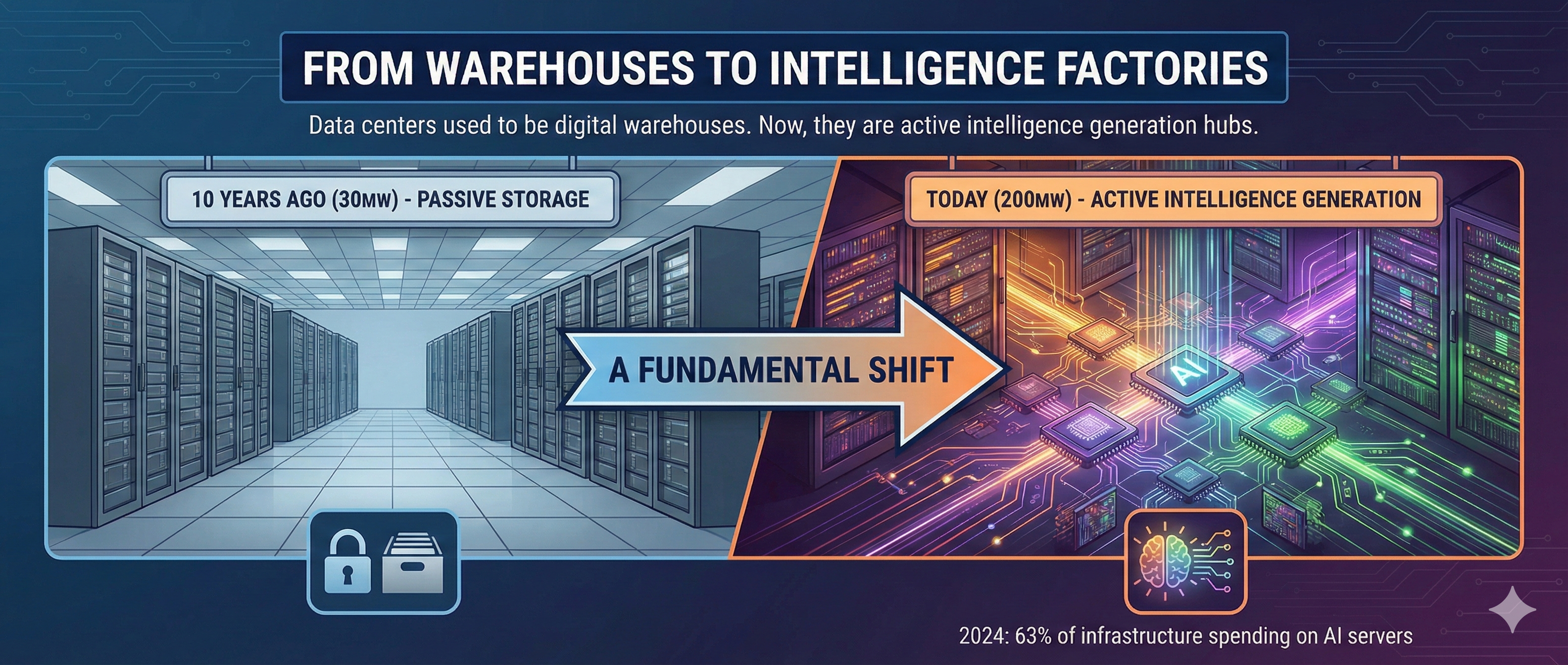
Ten years ago, a 30-megawatt data center was considered large.
Today, a 200-megawatt facility is normal.
That's not just growth. That's a fundamental shift in what these buildings do.
From Warehouses to Intelligence Factories
Data centers used to be digital warehouses. You stored information there. You retrieved it when needed. The value was in preservation and access.
That model is fading fast.
In 2024, data center servers accounted for 63% of total infrastructure spending. The reason? AI workloads have transformed these facilities from passive storage into active intelligence generation.
Modern AI data center racks process 865,000 tokens per second. They operate as single, giant accelerators rather than collections of separate machines. The infrastructure doesn't just hold data anymore—it analyzes, learns, and generates insights at unprecedented scale.
The Numbers Tell a Clear Story
The investment wave behind this transformation is staggering.
In 2024, data center spending reached $290 billion. Alphabet, Microsoft, Amazon, and Meta invested nearly $200 billion in capital expenditures. That figure is expected to climb by over 40% in 2025.
The global data center infrastructure market is on track to surpass $1 trillion in annual spending by 2030.
AWS, Microsoft, and Google Cloud plan to invest more than $250 billion in buildouts in 2025 alone.
This isn't speculative spending. Demand for AI-ready data center capacity will rise at an average rate of 33% per year between 2023 and 2030. By 2030, around 70% of total demand will be for data centers equipped to host advanced AI workloads.
Currently, only 14% of global data center power usage goes to AI. That proportion will multiply several times over in the next five years.
Supply Can't Keep Up
In Northern Virginia—the data capital of the world—the vacancy rate was less than 1% in 2024.
Prices charged by colocation providers for available data center capacity in the United States rose by an average of 35% between 2020 and 2023.
The availability of GPU and supporting infrastructure is supply constrained. Demand is so strong that the top four U.S. cloud service providers have turned away smaller customers.
"As fast as we actually put the capacity in, it's being consumed," Amazon CEO Andy Jassy said. He characterized AI as "a once-in-a-lifetime reinvention of everything we know."
Even the world's largest cloud provider struggles to keep pace.
The Power Challenge
This transformation comes with massive energy requirements.
Global power demand from data centers will increase 50% by 2027 and by as much as 165% by the end of the decade compared with 2023.
The density of power use in data centers will grow from 162 kilowatts per square foot to 176 kilowatts per square foot in 2027. AI processing workloads demand significantly more power than traditional computing.
A data center housing 30,000 GPUs consumes approximately 35.2 megawatts of power. That results in an annual electricity cost of $25.35 million. Energy alone accounts for 30-40% of total operating costs.
The infrastructure required to support intelligence processing is fundamentally different from what existed just a decade ago.
What This Means for Business Leaders
You rely on cloud services. You use AI tools. You make data-driven decisions.
The infrastructure supporting those capabilities is changing faster than most people realize.
Access to computing power is becoming a competitive advantage. Companies that secure capacity early gain speed and flexibility. Those waiting face delays, higher costs, and limited options.
Energy costs will shape strategic decisions. As power consumption rises, the location and efficiency of your data processing operations matter more. Businesses will need to consider energy availability when planning infrastructure investments.
The value equation has shifted. Data centers no longer compete primarily on storage capacity or retrieval speed. They compete on processing power, AI capability, and the ability to generate intelligence from raw data.
The Practical Reality
The global data center server market is projected to grow nearly fivefold from $204 billion in 2024 to $987 billion by 2030.
That growth reflects a simple truth: the value of data centers is increasingly tied to their ability to process and analyze, not simply store.
This drives innovation in hardware design, cooling systems, power management, and network architecture. Every component must support higher processing loads and greater energy efficiency.
For entrepreneurs and business leaders, this transformation creates both opportunities and constraints. AI tools become more powerful and accessible. But the infrastructure supporting them becomes more expensive and harder to secure.
Looking Forward
Data centers have evolved from storage facilities into intelligence factories.
The buildings look similar from the outside. Inside, everything has changed.
Understanding this shift helps you make better decisions about technology investments, vendor relationships, and strategic planning. The companies building and operating these facilities are betting trillions of dollars that intelligence processing will define the next decade of computing.
The evidence suggests they're right.
Video: https://youtu.be/imuKXT1AqyY?si=R9OAyH-OC5mCM85e




No comments:
Post a Comment