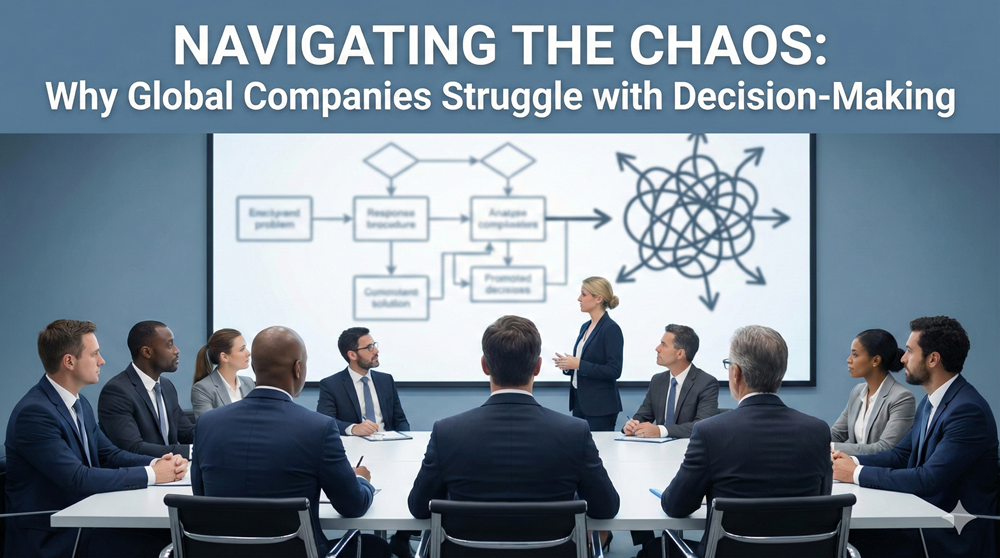
We talk about businesses as if they're machines that produce products or deliver services.
That's the output.
But the real engine running underneath? Decisions.
Every missed deadline, every duplicated effort, every moment of confusion in your organization traces back to how decisions get made—and how well they get made matters. Companies that make high-quality decisions quickly consistently outperform their competitors.
The question is: does your organization know how to make them well?
AI Amplifies What Already Exists
Here's what keeps me up at night about the AI revolution.
AI doesn't fix bad decision-making. It accelerates it.
Without structured, high-quality data and clear decision frameworks, AI amplifies chaos. A bad decision that used to impact dozens of customers now impacts thousands in minutes. 69% of leaders say poor data quality directly limits their ability to make informed decisions.
The speed advantage of AI only matters if your decision quality is already strong.
If your workflows are fragmented or unclear, AI will accelerate the confusion. The technology executes at unprecedented speed and scale, which means the quality of human judgment becomes paramount. One better decision can change the trajectory of your business. One amplified bad decision can sink it.
Four Questions Every Organization Must Answer
Most companies don't measure their decision effectiveness. They don't know how they stack up against competitors, and they can't tell whether they're getting better or worse over time.
This creates a dangerous blind spot.
The gap between perception and reality means organizations can't fix their decision quality if they don't know it needs fixing. Business leaders think their organizations have good decision quality, but McKinsey research shows that most companies report poor decision-making across different types of decisions, with only 20% of organizations consistently making high-quality decisions quickly.
To build a real decision-making engine, you need clear answers to four questions:
1. What decisions need to be made?
Not every choice deserves the same attention. Important decisions often get mired in head-banging meetings, debates, and consensus seeking. Meanwhile, routine decisions consume executive time that should go elsewhere.
Map your decision landscape. Identify which decisions are strategic, which are operational, and which can be automated or delegated.
2. Who owns each decision?
Consensus means no ownership.
What matters isn't that everyone agrees. It's that everyone is listened to, and then the right person makes a decision, communicates it clearly, and rallies everyone around it.
Organizations that follow decision best practices make decisions twice as fast in half as many meetings and find innovative solutions 75% more often. The RAPID framework breaks this down: Recommend, Agree, Perform, Input, Decide. Each role is essential, but only one person decides.
3. When does each decision need to happen?
Faster decisions tend to be higher quality.
This surprises people. We assume speed undercuts merit, but good decision-making practices yield decisions that are both high quality and fast. Companies that make high-quality decisions quickly and implement them effectively win more contracts, get to market faster, and beat out rivals.
The key is knowing which decisions need deep analysis and which need rapid execution.
4. Can we actually execute on this?
A decision without execution capability is just a wish.
Poor leadership begins with missed deadlines, unspoken frustrations, and meetings filled with compliance instead of collaboration. Over time, it erodes trust, weakens culture, and drains both people and profits.
Before you decide, ask: do we have the resources, skills, and systems to make this happen?
The Hidden Cost of Decision Dysfunction
Companies with disengaged employees experience 37% higher absenteeism and 18% lower productivity.
These aren't just HR problems. They're decision-making problems.
When organizations undervalue operational support roles and rely too heavily on individual endurance without support, they create environments where good decisions become impossible. People can't execute well when they're drowning in confusion about who decides what, when decisions need to happen, and whether anyone will follow through.
The workplace consequences are tangible. Low productivity often causes overtime work to meet set targets, with additional hours incurring extra wages. Missed deadlines leave clients feeling disheartened and providing inconsistent feedback. The cycle reinforces itself.
Building a Decision System That Scales
Successful organizations don't just make good decisions. They design systems that consistently produce good decisions at the right pace.
This requires balancing two forces that seem to oppose each other:
Autonomy with alignment.
People need freedom to make decisions in their domain without constant approval. But those decisions need to align with organizational strategy and values. The balance comes from clear frameworks, not micromanagement.
Organizations should shift from survival focus to thriving mindset, from reactive to proactive approaches. This means embedding decision-making frameworks into organizational culture, not treating them as occasional tools.
Data with discernment.
Good data informs decisions, but human judgment interprets context, weighs trade-offs, and considers long-term implications. AI can process information at scale, but it can't replace the strategic thinking that separates good companies from great ones.
Strategic alignment enhances organizational resilience. When decision-making processes connect employee growth with organizational goals, you create environments where people understand not just what to decide, but why it matters.
Leadership as System Design
The role of leadership is changing.
Leaders used to be the primary decision-makers. Now, they need to be architects of decision-making systems.
This means creating supportive environments for resilience, not relying on employee endurance without support. It means recognizing critical support functions and implementing enterprise-wide frameworks that embed accountability across the organization.
Confidence is the cornerstone.
Management confidence influences investor confidence, stakeholder confidence, and client confidence. When leaders demonstrate clear decision-making processes, communicate transparently, and follow through consistently, they build organizational cultures where good decisions become the norm.
Leadership must drive cultural shifts toward technology integration while maintaining the human judgment that makes decisions meaningful. The goal isn't to eliminate human decision-making. It's to amplify human capability through better systems.
The Question That Matters
Is your business making decisions, or just moving fast?
Speed without quality decision-making is just chaos at a higher velocity. Organizations that measure decision effectiveness, implement clear frameworks, and build cultures of accountability don't just survive. They thrive.
The companies winning today aren't necessarily the ones with the best products or the most resources. They're the ones that can make high-quality decisions quickly, communicate them clearly, and execute them effectively.
Your business is a decision-making engine.
The question is: how well is it running?




No comments:
Post a Comment