We hear it constantly: employees resist change. They're stuck in their ways. They fear the unknown.
But here's what the data actually shows.
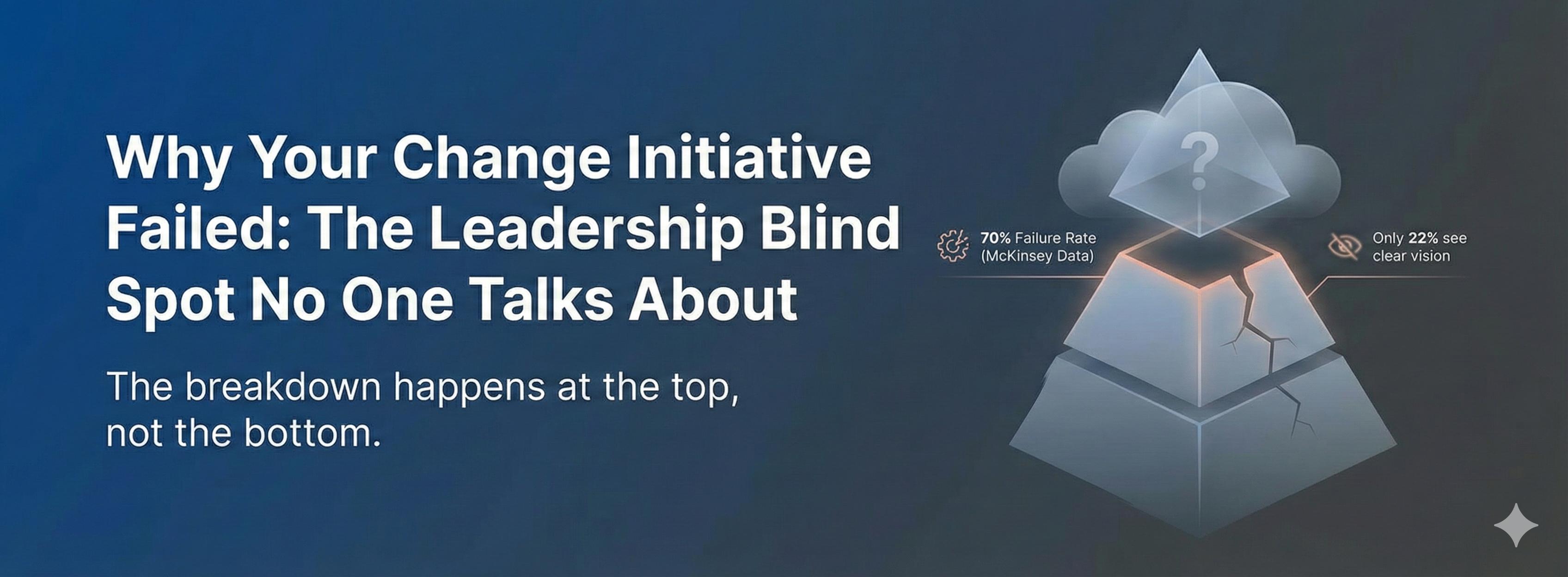
70% of organizational change efforts fail. McKinsey has tracked this pattern for years. The breakdown happens at the top, not the bottom.
Only 22% of employees believe their leaders have a clear vision. When executives send mixed messages, avoid disruption, or fail to model new behaviors, transformation loses momentum fast.
The real barrier to change isn't employee resistance. It's leadership ego.
The Disconnect Between Leaders and Teams
The gap between perception and reality is staggering.
74% of leaders say they involved employees in creating a change strategy. Only 42% of employees feel included.
This isn't a communication problem. It's a listening problem.
Tristan Boutros, SVP and Chief Transformation Officer at Warner Music Group, puts it plainly: "The ego is one of the biggest barriers to people working together effectively."
When managers give in to their egos, they insist on using ideas that haven't worked in the past. They refuse to consider suggestions from others. They ignore contributions from people they don't like. They do nothing because they fear being wrong.
The business impact is measurable. High turnover rates spike when employees deal with ego-based behavior from management. Top performers, in particular, will not tolerate an environment where their contributions are not valued.
How Ego Destroys Psychological Safety
Amy Edmondson's research at Harvard Business School identified psychological safety as the foundation of team learning and innovation.
Ego-driven leaders systematically destroy this foundation.
They shut down new ideas. They blame others for mistakes. They punish dissent. The result is an environment of fear where people stop speaking up.
A recent SHRM study confirmed that poor workplace culture is one of the top reasons employees seek new jobs. People don't leave companies. They leave leaders who make them feel unsafe.
Innovation dies in this environment. Teams stop experimenting. They stop learning. They focus on survival, not growth.
The CEO Hubris Problem
The higher a leader climbs, the fewer peers they have. Fewer people monitor their thinking, decisions, strategies, and actions.
This creates a dangerous feedback loop.
In a survey of 150 global CEOs, nearly one in five said they never doubt themselves. A 2013 study found that overconfident CEOs tend to make risky decisions about mergers and acquisitions.
The consequences are devastating. The CEO fails to see that customers are changing. R&D is stagnating. The product line is wildly out of date. Product quality is suffering. New competitors are moving faster. Costs are ballooning while revenue is declining.
They are blind to reality, living in their own self-engineered thought bubble.
Hubris becomes more dangerous over time. The more wins leaders accumulate, the less open they are to critical feedback. They become hooked on their own egos, so confident in their self-importance that they assume they can do no wrong.
What Actually Works: The Humility Gap
McKinsey research reveals an opportunity that most organizations miss.
Training in sponsorship—enabling others' success ahead of your own—supports both consultative and challenging leadership behaviors. Yet just 26% of organizations include it in development programs.
Development of situational humility is included by only 36%.
Team leaders have the strongest influence on psychological safety through their own actions. Creating a positive team climate pays additional dividends during disruption.
But here's the problem: only 27% of employees agreed their leadership is trained to lead teams through change. Only 25% of organizations have employees who say managing change is a major strength of senior leaders.
When change initiatives fail, they rarely fail on technical skills. They fail on people skills.
What This Means for Your Organization
Leadership ego blinds executives to the very human factors that determine success or failure.
You can have the best strategy, the most innovative technology, and the clearest vision. If your leaders refuse to acknowledge their own limitations or listen to feedback, the change will fail.
The solution starts with awareness.
Ask yourself: Do your leaders model the behaviors they expect from others? Do they admit when they're wrong? Do they actively seek dissenting opinions? Do they create space for people to challenge their thinking?
If the answer is no, you don't have a change management problem. You have a leadership development problem.
The organizations that adapt and thrive are the ones where leaders check their egos at the door. They build cultures of intellectual humility. They prioritize psychological safety. They understand that their job isn't to have all the answers—it's to create an environment where the best answers can emerge.
Change doesn't fail because people resist it. Change fails because leaders refuse to lead it differently.
The question isn't whether your employees are ready for change. The question is whether your leadership is humble enough to guide it.



No comments:
Post a Comment