I'm tracking a shift in consumer behavior that most business strategists are still trying to understand.
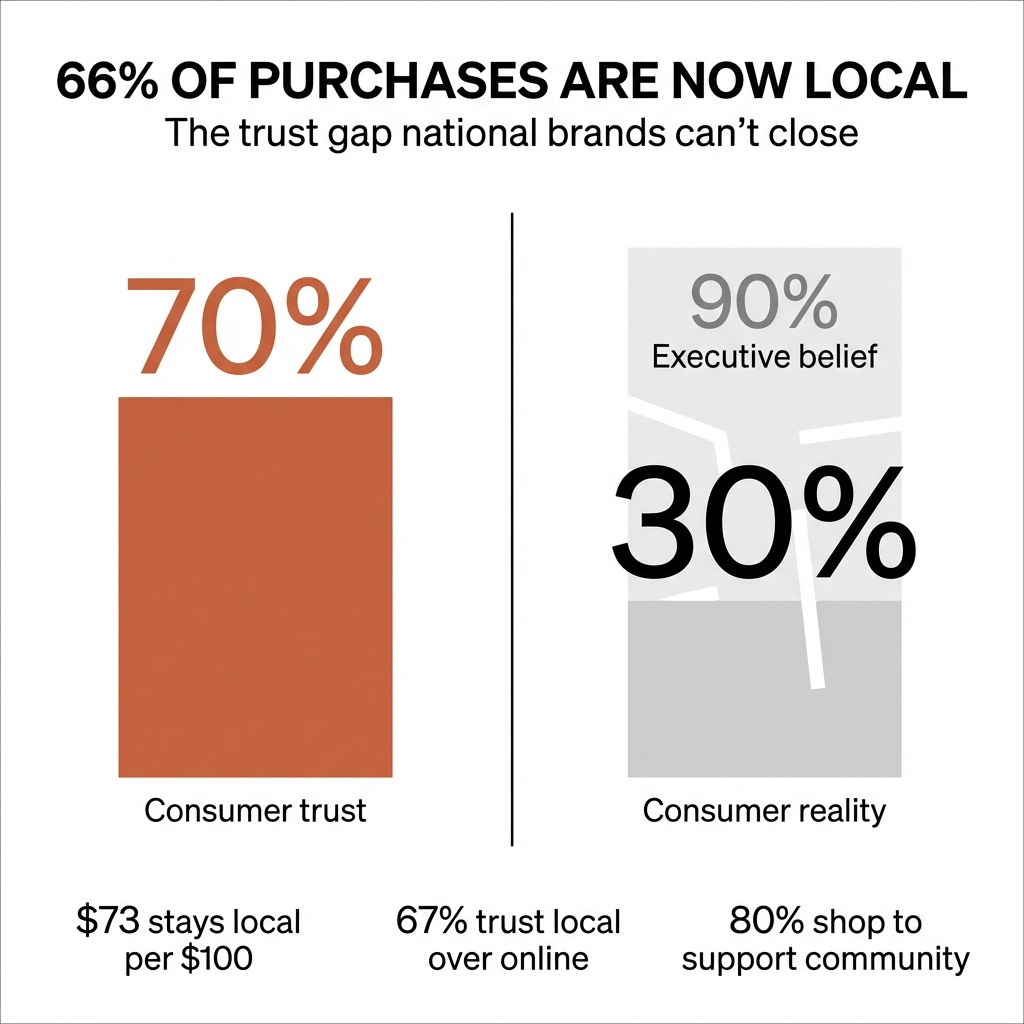
Local brands now capture 66% of consumer brand choices. That number represents a fundamental change in how people decide what to buy.
The data tells a clear story. 70% of U.S. adults express confidence in small businesses, making them the most trusted institution in America. This beats corporations, government, and other major institutions by a significant margin.
The Trust Gap National Brands Can't Close
National brands face a problem they created themselves.
There's a 60-percentage-point disconnect between what executives believe and what consumers actually think. 90% of executives believe their companies are highly trusted by customers. Only 30% of consumers agree.
Local brands don't have this problem. 67% of consumers trust local businesses more than online-only companies. The reason is simple: proximity creates accountability.
When you can walk into a store and talk to the owner, trust becomes tangible. When a business operates in your community, you see the impact of their decisions. National brands operate at a distance that makes genuine connection difficult.
Supply Chain Reliability as Competitive Advantage
The pandemic exposed weaknesses in global supply chains that local brands don't share.
Local brands source locally. This creates shorter supply chains, faster response times, and fewer points of failure. When disruption hits, local businesses adapt faster because they control more of their value chain.
Vertical integration works differently at the local level. Instead of owning factories across continents, local brands build relationships with nearby suppliers. These relationships provide flexibility that global logistics can't match.
For every $100 spent at a local business, up to $73 remains in the community. Chain stores retain just $43. This economic multiplier effect creates a feedback loop that strengthens local supply networks.
Perceived Quality Through Community Connection
Quality perception has shifted from brand recognition to community validation.
Local brands leverage three distinct advantages: local iconness, domestic production, and national origin. Family businesses and local brands benefit from all three simultaneously.
52% of consumers feel a personal connection to the brands they buy. 54% choose retailers specifically because they carry local brands that matter to them. This creates a differentiation strategy that national brands struggle to replicate.
The quality signal comes from community endorsement rather than advertising spend. When your neighbor recommends a local business, that carries more weight than a national marketing campaign.
Community Loyalty as Brand Equity
80% of people shop locally specifically to support their community. 78% of shoppers are willing to spend more to buy local.
This willingness to pay premium prices represents real brand equity. Local brands build this equity through consistent community presence, not through mass media campaigns.
The customer value proposition for local brands centers on community impact. Every purchase becomes a vote for local economic health. National brands can't offer this value proposition authentically because their profits flow out of the community.
47% of U.S. consumers now prioritize locally owned companies in purchase decisions. This represents a structural shift in how people evaluate value.
The Generational Shift
58% of Gen Z and Millennials are willing to pay premiums for transparent sourcing practices and ethical products.
Younger demographics drive the local brand movement because they prioritize authenticity and accountability over brand recognition. They grew up with access to information about supply chains, labor practices, and environmental impact.
This generation views purchasing as a form of activism. Local brands align with this worldview because their impact is visible and measurable.
What National Brands Get Wrong
National brands try to solve the trust problem with marketing. They launch "local" campaigns, create "community" initiatives, and talk about "values."
Consumers see through this. The fundamental structure of national brands creates distance. Decisions get made in distant headquarters. Profits flow to shareholders in other states or countries. Supply chains span continents.
Even Nike was displaced by nimble local competitors like Hoka and On Holdings. These brands grew rapidly through innovative product design and targeted marketing that connected with specific communities.
The Economic Reality
Every $1 million spent on local food supports 13 on-farm jobs and generates a $1.98–$2.64 economic multiplier.
This economic impact creates a virtuous cycle. Local businesses hire locally, source locally, and reinvest locally. The money recirculates six to 15 times within the community.
National brands extract value from communities. Local brands create value within communities. This difference becomes more visible as consumers pay closer attention to economic impact.
What This Means for Business Strategy
The shift toward local brands represents a fundamental change in competitive dynamics.
Differentiation strategy now requires genuine community connection. You can't fake local presence. You can't manufacture community trust through advertising.
Brand equity builds through consistent community engagement, transparent operations, and visible local impact. The frameworks that worked for national brand building don't translate to local markets.
Customer value proposition must center on community benefit. Price, quality, and convenience still matter, but they're table stakes. The real value comes from supporting local economic health.
Supply chain strategy needs to prioritize resilience over efficiency. Shorter supply chains, local sourcing, and direct relationships with suppliers create competitive advantages that global logistics can't match.
The Path Forward
Local brands are winning because they solve problems that national brands created.
They offer trust through proximity. They provide supply chain reliability through local sourcing. They deliver quality validated by community endorsement. They build loyalty through genuine community impact.
This trend will continue because it's driven by structural factors, not temporary preferences. The economic multiplier effect of local spending creates self-reinforcing cycles. The generational shift toward values-based purchasing accelerates the movement.
National brands can't compete on these dimensions without fundamentally restructuring their operations. Local brands don't need to change anything. They just need to keep doing what they're already doing: serving their communities authentically.


No comments:
Post a Comment