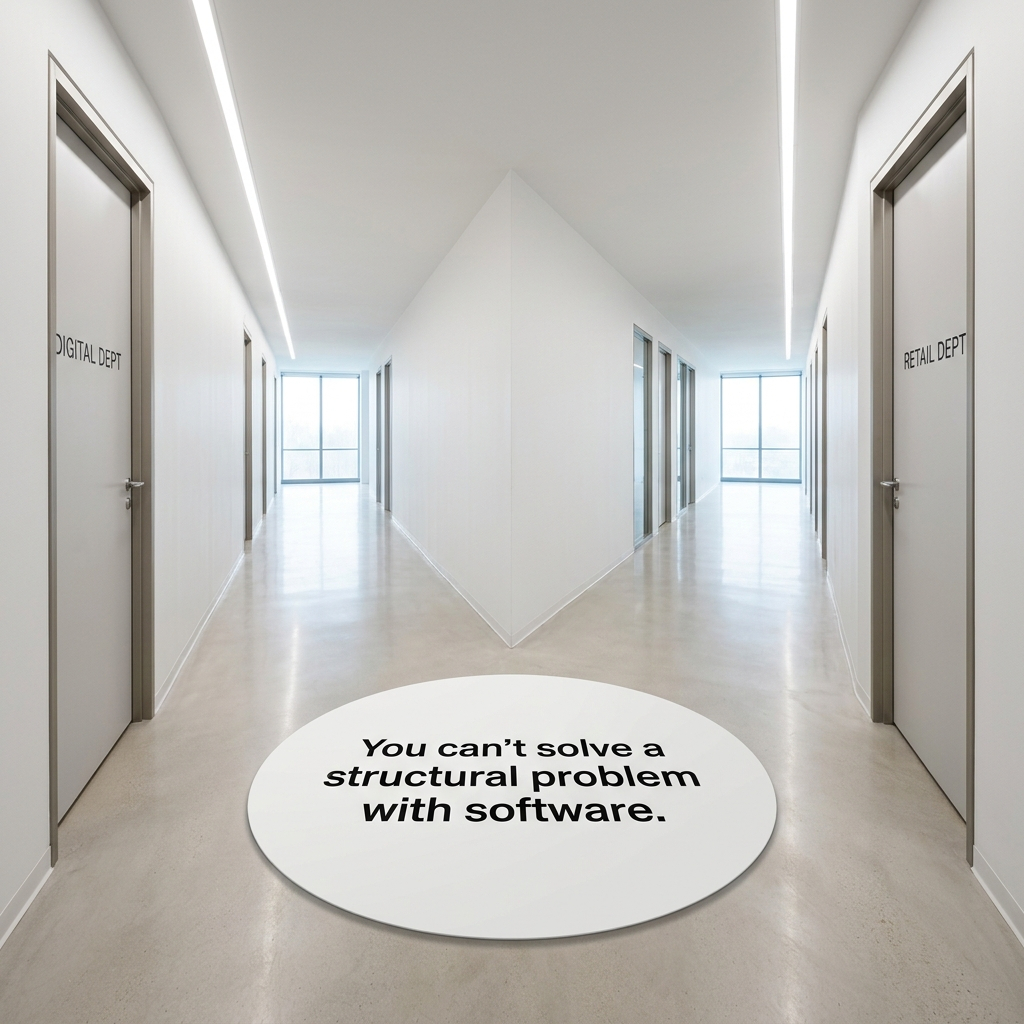
Companies pour millions into omnichannel technology following the same pattern every time.
Same pattern every time. New CRM. Integrated analytics platform. Mobile app refresh. Leadership announces the transformation. Six months later, customers still get different answers from the website, the store, and customer service.
The technology worked fine.
The problem was organizational. Your digital team reports to one VP. Your store managers report to another. Your customer data lives in three different systems because three different departments own three different pieces of the customer journey.
You can't solve a structural problem with software.
The Data Tells You Where the Money Is
Omnichannel customers spend 4% more in stores and 10% more online than single-channel shoppers. These are your most valuable customers.
You lose 80% of them when your organization can't coordinate across channels.
That's not a technology failure. That's an organizational failure.
I've seen retailers run omnichannel marketing campaigns that achieve 287% higher purchase rates than single-channel efforts. Then I watch those same companies organize their teams by channel—digital, retail, call center—creating internal competition for the same customer.
You built silos. Then you bought technology to connect them. The silos won.
Home Depot Proved the Point
Home Depot ran campaigns that required 13 weeks and 30 approvals. Online team had their process. Store team had theirs. Marketing sat in the middle trying to coordinate.
They reorganized. Broke down the channel walls. Cut timelines to 3 weeks and approvals to 3 people.
Same technology. Different structure.
The technology didn't change their speed. The organizational model did. When your teams compete for budget, attention, and credit, your customers pay the price in disconnected experiences.
Cross-Functional Teams Deliver Measurable Results
Retailers with cross-functional teams see 20% fewer operational bottlenecks and resolve problems 15% faster than siloed organizations.
Projects with strong cross-functional collaboration have a 76% success rate. Projects with moderate support? 19%.
Organizational structure is the single biggest predictor of omnichannel success or failure.
Yet less than half of retailers have dedicated omnichannel teams working across business functions. Most companies deploy omnichannel technology but maintain siloed organizational structures.
You guarantee underperformance when your org chart contradicts your customer experience strategy.
What Actually Works
I'm not suggesting you reorganize every quarter. I watched one retailer reorganize three times in three years. They fell from first to third place in digital sales.
Changing structure alone fails without corresponding changes in capabilities, alignment, and decision rights.
Here's what works:
1. Create Shared Accountability
Your digital VP and retail VP need the same performance metrics. Not digital metrics and retail metrics. Customer metrics.
When both leaders succeed or fail together based on total customer value, silos become expensive. Collaboration becomes profitable.
2. Unify Your Data Model
This isn't about buying another integration platform. This is about organizational ownership.
Who owns the customer record? One team. One source of truth. When your CRM team maintains separate databases from your loyalty program team, you fragment customer understanding before technology even enters the equation.
McKinsey found organizations fail to evolve their supply chain operating model—processes, structures, and people—even when technology works perfectly. Siloed structures prevent companies from sustaining omnichannel changes once leadership attention shifts.
3. Design Decision Rights for Speed
Home Depot went from 30 approvals to 3 by clarifying who decides what. Not who gets consulted. Who decides.
Map your customer journey. Identify the handoffs between teams. Every handoff is a decision point. Every decision point is a potential delay.
Reduce handoffs. Clarify authority. Speed follows structure.
4. Build Capabilities, Not Just Roles
Your store managers need to understand digital analytics. Your digital team needs to understand store operations. Cross-training isn't optional when customer experience crosses channels.
I've seen companies hire "omnichannel directors" and expect them to fix organizational silos through force of personality. That person quits within 18 months because they have responsibility without authority.
Build capabilities across teams. Then give those teams the authority to act on what they learn.
The Real Cost of Organizational Silos
You lose customers. You waste marketing spend. You slow down decision-making.
But the biggest cost is strategic.
When your organization is structured around channels, you optimize channels. You measure channel performance. You reward channel success.
Your customer doesn't care about channels. They care about solving their problem. When your internal structure prevents you from seeing the customer as a whole person with a continuous journey, you make decisions that serve your org chart instead of your customer.
That's how market leaders become market followers.
Start With Structure, Not Software
I'm not against technology. I'm against using technology as a substitute for organizational clarity.
Before you buy the next integration platform, answer these questions:
Who owns the end-to-end customer experience?
What metrics do you share across digital, retail, and service teams?
Where do handoffs between teams slow down decisions or create inconsistent customer experiences?
Who has the authority to change processes that cross departmental boundaries?
If you can't answer those questions clearly, your next software purchase won't fix your omnichannel problem. It will just automate your organizational dysfunction.
The Path Forward
Omnichannel isn't a technology challenge. It's a business model challenge.
You're trying to deliver a unified customer experience through a fragmented organizational structure. The math doesn't work.
Start with your org chart. Align accountability. Unify data ownership. Clarify decision rights. Build cross-functional capabilities.
Then buy the technology.
Your CRM will work a lot better when your organization is designed to support it.


No comments:
Post a Comment