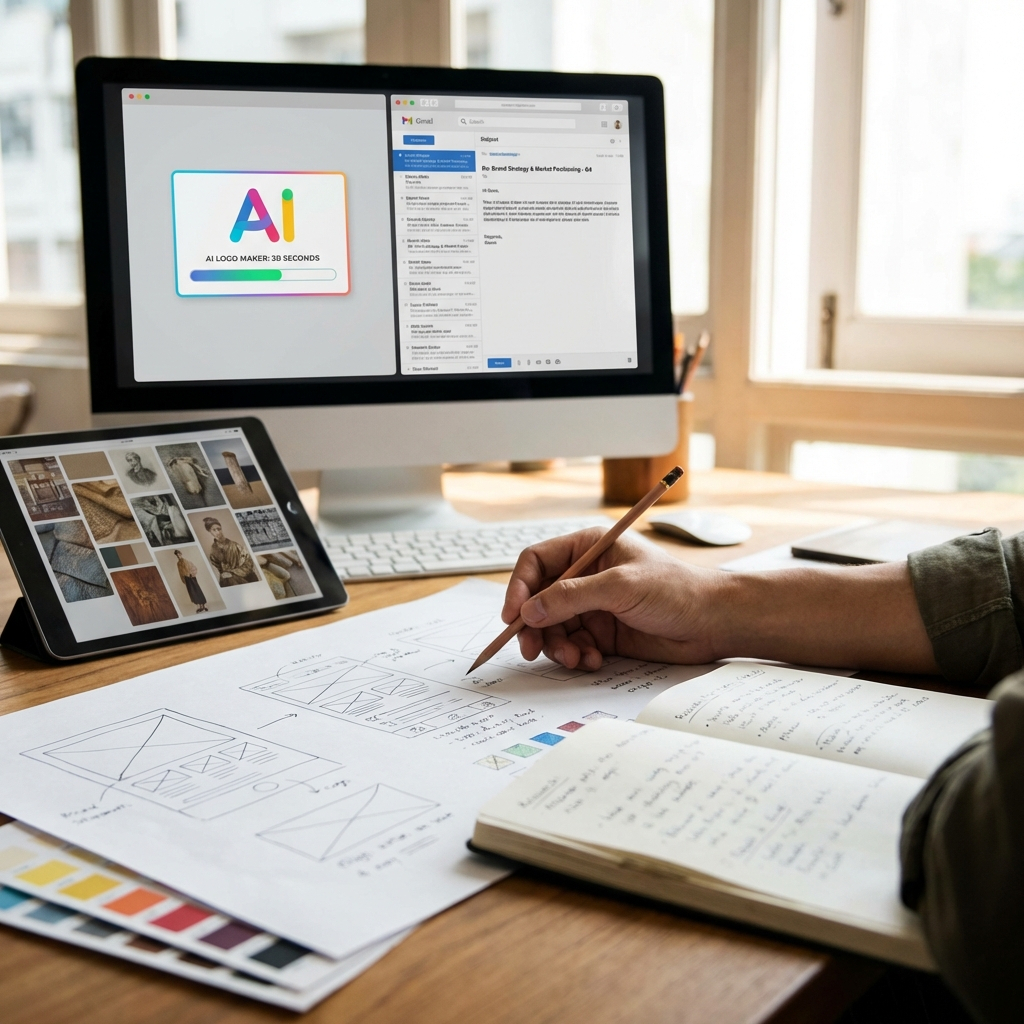
You can generate a logo in 30 seconds now.
Type a prompt. Click a button. Download the file.
The cost? Almost nothing. The time saved? Hours, maybe days.
So why are businesses that rush to replace their graphic designers with AI tools watching their brand recognition drop and their conversion rates stall?
Because people form opinions about your brand in 0.05 seconds, and up to 90% of that judgment comes from visuals alone. When those visuals look like everyone else's, you blend into the background before anyone reads a single word.
The Real Cost of Generic
AI image generators work by recognizing patterns in millions of existing designs. They remix what already exists. The output looks professional enough at first glance, but it lacks the strategic thinking that separates memorable brands from forgettable ones.
Even design professionals testing AI logo tools admit the results "can feel a bit generic" and lack "excitement or a unique spark." When the people building these tools acknowledge the limitations, you should pay attention.
Here's what AI can't do:
Understand your customer's psychology. Color drives 85% of purchase decisions. The right shade of blue signals trust. The wrong one signals cheap. AI picks colors based on what's common in its training data. A human designer picks colors based on who you're trying to reach and what you want them to feel.
Create strategic differentiation. Your competitor can use the same AI tool with a similar prompt and get a similar result. Human designers study your market, identify gaps, and position your brand where it stands out. That's the difference between looking professional and looking distinct.
Build consistency across touchpoints. Businesses with consistent branding outperform competitors by 20%. A logo is just the start. You need that visual language to work across your website, social media, packaging, and marketing materials. AI generates individual images. Designers build systems.
When Cost Savings Backfire
Major brands have learned this lesson publicly.
Coca-Cola's 2024 AI-generated Christmas ad was criticized as a "low effort attempt" and accused of being "the blood of out-of-work artists." Toys 'R' Us's AI brand video was called an "abomination" by advertising professionals. Sports Illustrated's AI content scandal led to the CEO being fired.
These weren't small companies making rookie mistakes. They were established brands that prioritized speed and cost over strategic communication. The backlash damaged their reputation more than the savings helped their bottom line.
The pattern is clear. When you cut corners on visual identity, customers notice. They feel it before they can articulate why.
What Graphic Designers Actually Do
I've watched businesses treat graphic design like decoration. Something you add at the end to make things look nice.
That misses the point entirely.
Professional designers translate business strategy into visual language. They ask questions AI never will:
Who are you trying to reach? What do they value? What makes them choose one brand over another? How do your competitors position themselves visually? Where's the gap you can own?
They understand that design decisions communicate messages. A minimalist layout signals sophistication. Bold typography signals confidence. Soft edges signal approachability. These aren't arbitrary choices. They're strategic signals that shape how people perceive your business before they engage with your product.
Research backs this up. Design-driven companies experienced 32% more revenue growth over five years compared to competitors. That's not because their logos were prettier. It's because their visual communication reinforced their market position at every customer touchpoint.
The Hidden Problem with AI Visuals
Studies show consumers view AI-generated images as less authentic, which undermines trust in brands. When your visuals feel artificial, people question whether your business is genuine.
This matters more than you think. Trust drives purchase decisions. Authenticity builds loyalty. When customers sense something is off about your branding, they move on to competitors who feel more real.
AI tools also create inconsistency problems. You might generate a great hero image for your homepage, but when you need supporting graphics for social media or email campaigns, getting AI to maintain the same style and tone becomes difficult. You end up with a patchwork of visuals that don't quite fit together.
Human designers build cohesive systems. They create style guides, establish visual rules, and ensure every piece of content reinforces your brand identity. That consistency is what makes brands recognizable and memorable.
When AI Makes Sense
AI image generation has legitimate uses. It works well for:
Rapid prototyping. Testing concepts quickly before investing in final designs.
Stock imagery alternatives. Generating background images or placeholder content.
Internal communications. Creating visuals for presentations or internal documents where brand consistency matters less.
The key is knowing where AI adds value and where it creates problems. Using it to replace strategic design work saves money in the short term but costs you market position over time.
The Real Question
You're not choosing between AI and human designers. You're choosing between generic visual communication and strategic brand building.
AI generates images. Designers solve business problems through visual strategy.
If your goal is to look professional enough to not embarrass yourself, AI tools can get you there. If your goal is to stand out in a crowded market, build customer trust, and create a brand people remember, you need human expertise.
The businesses winning in competitive markets understand this. They use AI for speed and efficiency where it makes sense. They invest in designers for strategy and differentiation where it matters.
Your brand is how customers recognize you, trust you, and choose you over alternatives. That's not something you want to leave to pattern recognition algorithms trained on millions of generic examples.
The cost of professional design is visible on your invoice. The cost of generic AI visuals shows up in metrics you might not connect at first—lower conversion rates, weaker brand recall, reduced customer loyalty, and slower growth.
By the time you notice the problem, your competitors who invested in strategic design have already captured the market position you're trying to claim.


No comments:
Post a Comment