I've been analyzing content performance data for years now, and I keep seeing the same pattern.
Teams publish more. Traffic stays flat. Engagement drops. Leadership asks for even more content.
The problem isn't volume. It's that nobody stops to eliminate what isn't working.
Most content strategies are purely additive. You create a calendar, fill it with topics, and ship relentlessly. But 90.63% of all published pages get zero organic traffic from Google. You're sitting on mountains of invisible content that dilutes your signal.
I built a framework to change that. It's not about creating more. It's about identifying what deserves to stay, what needs to go, and what should get doubled down on.
The Real Problem With Additive Content Strategies
Every content team I've worked with starts the same way. They build a publishing calendar. They assign topics. They hit deadlines.
Then six months later, they have 50 blog posts, 20 videos, and a dozen guides. Traffic hasn't moved. Leads are stagnant.
The instinct is always to create more. More formats. More platforms. More frequency.
But more content doesn't equal more results. It equals more noise.
Search engines have limited crawl budgets for each site. When you publish low-quality or outdated content, Google wastes time indexing pages that don't matter. HubSpot deleted around 3,000 pages from their blog in 2019, saving several hours in getting their content indexed by Google's crawlers.
The math is simple. If 90% of your content gets zero traffic, you're asking search engines to crawl through junk to find your best work.
That's not a content problem. That's a prioritization problem.
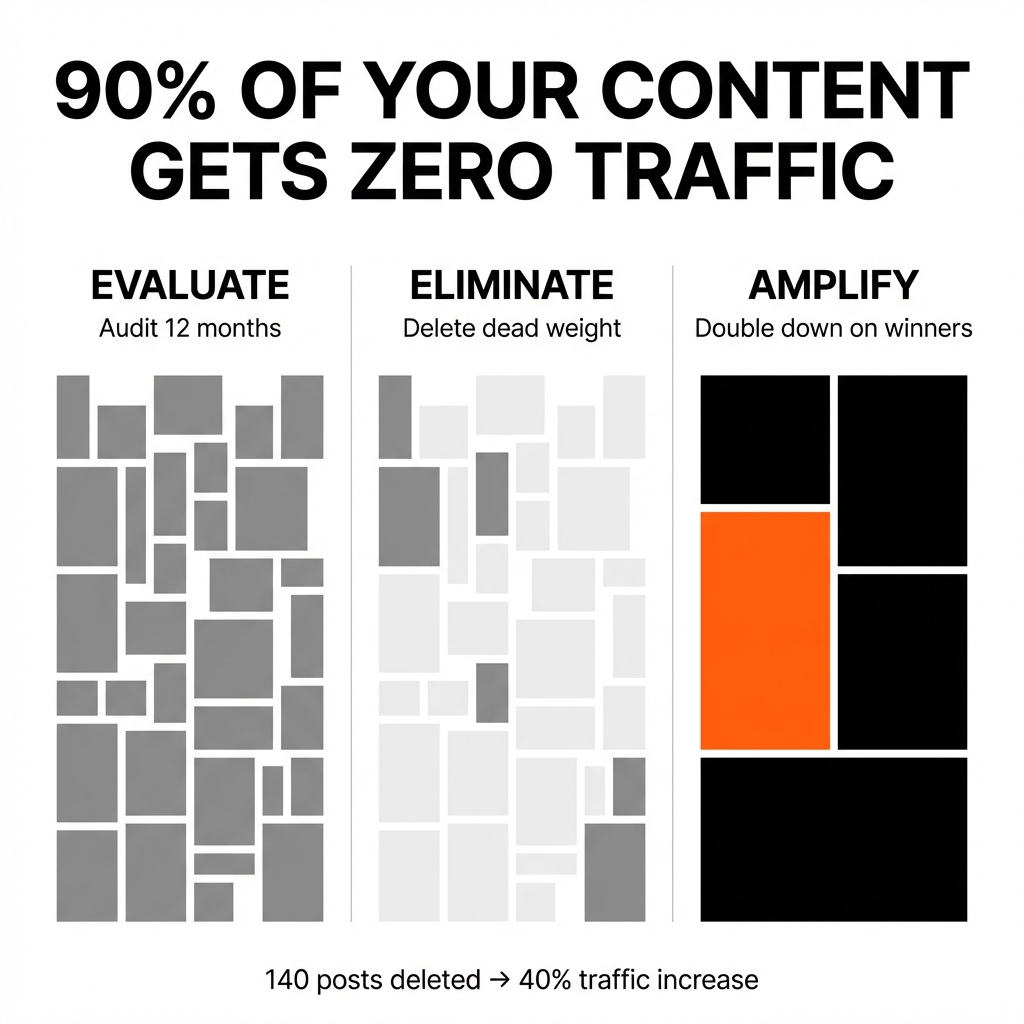
The Framework: Evaluate, Eliminate, Amplify
I use a three-stage framework to clean up content portfolios. It's not complicated, but it requires discipline.
Stage 1: Evaluate What You Have
You can't fix what you don't measure. Start by auditing every piece of content you've published in the last 12 months.
Track these metrics:
Organic traffic – How many people find this content through search?
Engagement time – Are people reading or bouncing immediately?
Conversion actions – Does this content drive signups, downloads, or purchases?
Backlinks and shares – Is anyone referencing or amplifying this content?
Don't track vanity metrics. Metrics can quickly become all-consuming and confusing, especially if you gauge performance against too many goals. Focus on what ties directly to business outcomes.
Research shows that high-quality, relevant content generates 9.5 times more leads than low-quality, non-targeted content. Signal beats volume every time.
Once you have the data, segment your content into three categories:
Winners – Content that drives traffic, engagement, and conversions consistently.
Underperformers – Content that gets some traffic but doesn't convert or engage.
Dead weight – Content with zero traffic, zero engagement, and no clear purpose.
Stage 2: Eliminate What Isn't Working
This is where most teams freeze. They've invested time and budget into content. Deleting it feels like admitting failure.
But keeping dead weight hurts you. It confuses search engines. It dilutes your authority. It wastes crawl budget.
Here's how I decide what to delete:
Delete outdated content. If a post references tools, statistics, or strategies that are no longer relevant, remove it. Up to 65% of all AI search-bot hits go to content updated in the last 12 months. Outdated content doesn't just fail to rank. It actively damages your credibility.
Delete duplicate content. If you have three blog posts covering the same topic with slightly different angles, consolidate them. Content pruning can increase top URL impression share by approximately 20% when overlapping posts are merged into single survivor pages per intent cluster.
Delete low-quality content. If a post was rushed, thin on insight, or written just to fill a calendar slot, delete it. You're not helping anyone by keeping it live.
💡 Tip: Before deleting, check if the URL has backlinks. If it does, set up a 301 redirect to a related, higher-quality page. You keep the SEO value without keeping the junk.
Stage 3: Amplify What Works
Once you've cleared the dead weight, you can see your winners clearly.
Now double down.
Update and expand your best content. Take your top-performing posts and make them better. Add new data. Include recent examples. Deepen the analysis. Fresh content gets prioritized by search engines and AI platforms.
Repurpose winners into new formats. If a blog post drives traffic, turn it into a video, a podcast episode, or a downloadable guide. You're not creating from scratch. You're amplifying what already works.
Build internal linking structures around winners. Use your best content as hub pages. Link related posts to them. This signals to search engines that these pages matter.
Promote winners consistently. Your best content deserves ongoing distribution. Share it in newsletters. Reference it in new posts. Use it in onboarding sequences.
The goal isn't to create more. It's to make your best work impossible to miss.
Why This Framework Works in an AI-Driven World
Traditional search engine volume will drop 25% by 2026 as AI chatbots absorb queries, according to Gartner research. That shift changes how content gets discovered.
AI platforms prioritize fresh, authoritative content. They don't crawl your entire site. They surface what's most relevant and recent.
If your site is cluttered with outdated, low-quality posts, AI tools skip over you. If your site is clean, focused, and consistently updated, you get prioritized.
This isn't about gaming algorithms. It's about clarity.
When you eliminate what doesn't work, you make it easier for search engines, AI platforms, and real humans to find what does.
How to Implement This Framework
Start small. Don't try to audit your entire content library in one week.
Month 1: Audit your last 12 months of content. Export traffic, engagement, and conversion data. Segment everything into winners, underperformers, and dead weight.
Month 2: Delete dead weight. Start with content that has zero traffic and no backlinks. Set up redirects where needed. Track the impact on crawl efficiency and indexing speed.
Month 3: Consolidate underperformers. Merge overlapping posts. Redirect old URLs to the new consolidated versions. Measure impression share and ranking changes.
Month 4: Amplify winners. Update your top 10 posts with fresh data and examples. Repurpose them into new formats. Build internal linking structures around them.
Ongoing: Make elimination part of your process. Every quarter, review what you've published. Delete what didn't work. Update what did. Stop treating content like it's permanent.
What This Looks Like in Practice
I worked with a SaaS company that had published 200 blog posts over three years. Traffic was flat. Conversions were declining.
We audited everything. 140 posts had zero traffic. 30 posts were outdated. 20 posts were duplicates.
We deleted 120 posts. We consolidated 30 into 10. We kept 50 and updated them aggressively.
Within six months, organic traffic increased 40%. Time on page went up 25%. Lead conversions doubled.
We didn't create more content. We eliminated what wasn't working and amplified what was.
The Hard Truth About Content Strategy
Most teams avoid this framework because it feels like admitting failure.
You spent time writing those posts. You invested budget in production. Deleting them feels wasteful.
But keeping them is more wasteful.
Every piece of low-quality content you leave live dilutes your authority. It wastes crawl budget. It confuses your audience. It makes your best work harder to find.
The goal isn't to publish more. It's to make every piece of content you keep worth finding.
Stop adding. Start eliminating. Then amplify what's left.
That's how you build a content strategy that actually works.


No comments:
Post a Comment