I've been watching the lunar economy unfold, and something clicked when I saw the numbers.
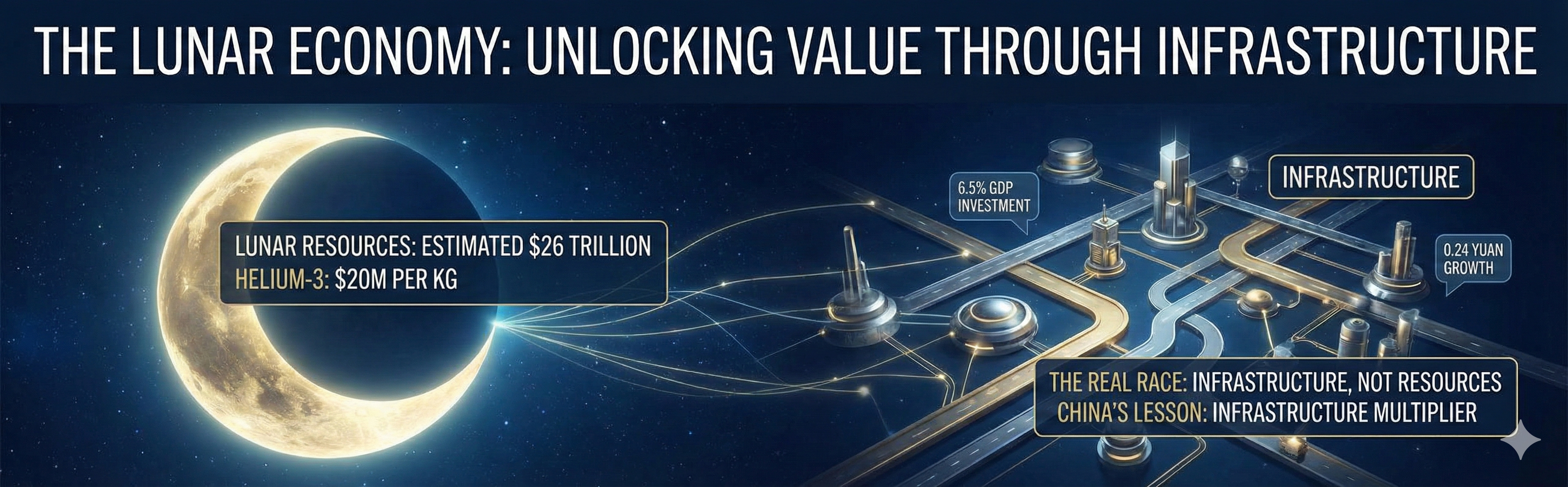
The moon holds an estimated $26 trillion in resources. Helium-3 alone is valued at $20 million per kilogram. Companies are signing purchase agreements worth hundreds of millions. The U.S. Department of Energy has already committed to buying three liters of moon-harvested helium-3 by April 2029.
This isn't speculation anymore. It's commerce.
The Real Race: Infrastructure, Not Resources
Here's what most people miss about frontier markets.
The value isn't in the resources themselves. It's in who controls the infrastructure to extract and transport them.
China understood this in the 1990s. The country invested 6.5% of GDP in infrastructure when the average developing nation spent 4%. By 2009, coastal provinces were investing 15-20% of GDP in roads, ports, and power systems.
The result? Every yuan invested in transport infrastructure generated 0.24 yuan in GDP growth in central regions. That's the multiplier effect in action.
The moon follows the same logic.
Building Toll Booths in Space
More than 400 missions are forecast to launch to the moon between 2022 and 2032. Each one needs power, communication networks, and landing infrastructure.
The first entity to build these systems controls access.
DARPA's LunA-10 program is funding companies to develop "commercially owned-and-operated lunar infrastructure." Intuitive Machines has NASA contracts worth up to $4.82 billion over 10 years for Near Space Network services.
This is the government acting as investor of first resort. They're funding the infrastructure buildout, then becoming procurement agencies once the systems are operational.
Sound familiar? It's the same model that built highways, railways, and the internet.
Territory Through Infrastructure
The 1967 Outer Space Treaty says no nation can claim lunar territory.
But here's the loophole: infrastructure creates de facto control zones.
A nuclear power source on the moon can impose "keep out zones" for safety purposes. A communication relay can charge fees for data transmission. A landing pad can set access terms.
You don't need to own the land if you own the only road to it.
The Next Decade Decides Everything
The global space economy hit $613 billion in 2024. Projections show it reaching $1 trillion by 2032.
Helsinki-based Bluefors signed a deal worth $300 million to purchase up to 1,000 liters of lunar helium-3 annually from startup Interlune. These aren't future plans. These are signed contracts.
The infrastructure gap is closing fast.
The companies and nations that build lunar infrastructure now will control market access for generations. The rest will pay tolls to use systems they didn't build.
This is how frontier markets work. The infrastructure builders become the gatekeepers. The resource extractors become the tenants.
The moon is no different.
What This Means for You
If you're tracking emerging markets, the lunar economy offers a clear parallel to every frontier market that came before it.
Watch the infrastructure investments, not just the resource valuations. Track which companies are building power systems, communication networks, and transportation hubs.
Those are the positions that matter.
The gold rush gets the headlines. The people selling picks and shovels build the fortunes. In space, the picks and shovels are power grids, landing pads, and data networks.
The race to build them has already started.




No comments:
Post a Comment