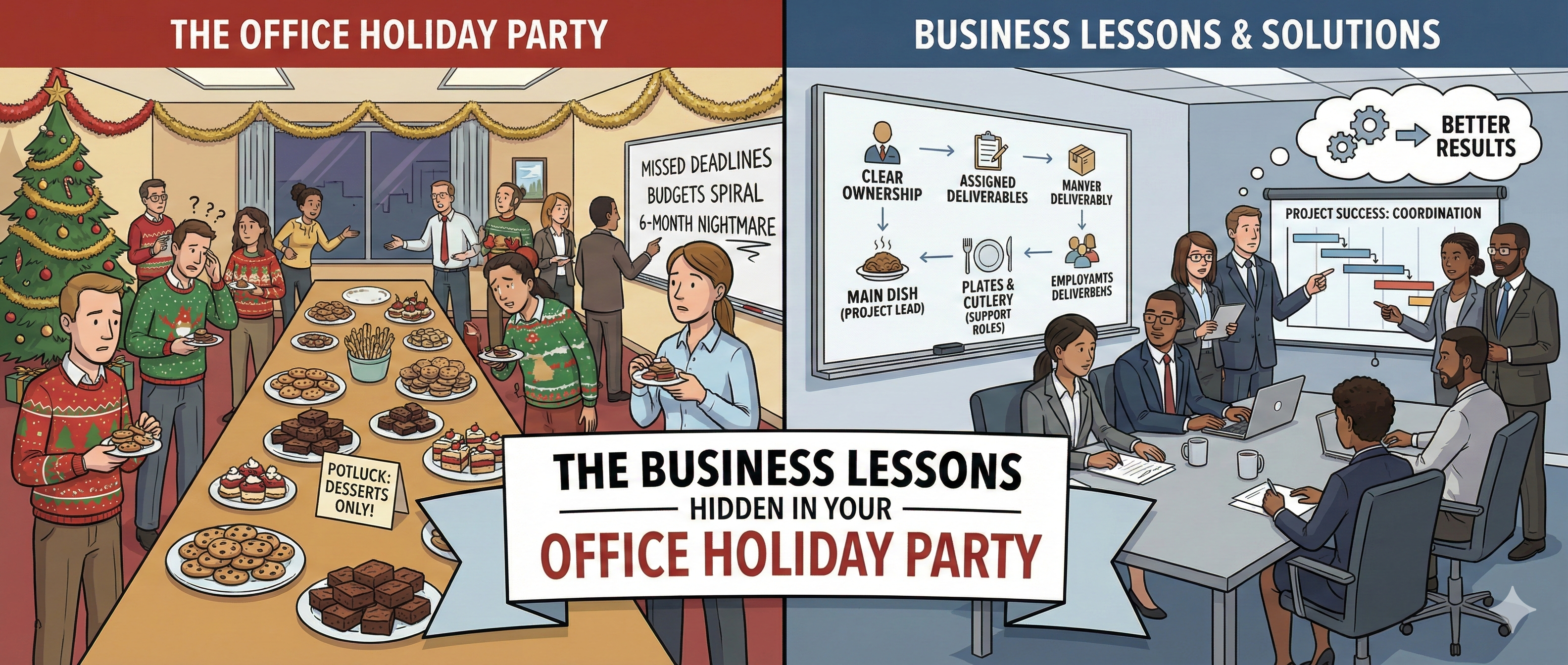
Your company holiday party reveals more about organizational behavior than any MBA case study.
Watch closely. The same dynamics that make December gatherings awkward also explain why teams miss deadlines, why budgets spiral, and why that "quick project" turned into a six-month nightmare.
The Potluck Problem: When Everyone Brings Dessert
Every office potluck faces the same crisis. Seven people bring cookies. Nobody brings plates.
This is the **coordination problem** in action.
When you don't assign clear ownership, people default to what's comfortable. Sarah makes her famous brownies because baking feels safe. Nobody volunteers for the main dish because it requires more effort and higher stakes.
Your projects work the same way. Without explicit role assignment, everyone gravitates toward familiar tasks. Three people redesign the logo. Nobody writes the implementation plan.
The fix: Assign specific deliverables before the meeting. "Who's bringing the turkey?" gets better results than "Let's all contribute something."
Secret Santa Economics: The $20 Gift Card Phenomenon
You set a $25 limit for Secret Santa. Half the gifts are $20 Starbucks cards.
Welcome to **adverse selection**.
When you can't measure effort or creativity, people optimize for convenience. The gift card requires zero research, zero risk, and zero thought. It meets the requirement without exceeding it.
This happens in your business when you reward activity instead of outcomes. Set vague goals and watch your team deliver the corporate equivalent of gift cards: technically correct, functionally useless.
You want thoughtful work? Measure what matters. Reward the outcome, not the receipt.
The Ugly Sweater Contest: Signaling Theory in Knitwear
Dave from accounting shows up in a sweater with working LED lights and a musical sound chip.
He didn't do this for fun. He did it for **status signaling**.
The uglier and more elaborate the sweater, the stronger the message: "I'm secure enough in my position to look ridiculous." Senior leaders wear the most outrageous sweaters because they have the least to prove.
Your workplace runs on similar signals. The executive who shows up in jeans signals confidence. The new hire who overdresses signals insecurity.
Pay attention to what people signal through small choices. The manager who never admits mistakes is signaling fragility. The team member who asks "dumb" questions is signaling strength.
The Buffet Line: Scarcity and the Shrimp Effect
The shrimp disappears in four minutes. The vegetable tray sits untouched until someone takes pity on it at 8pm.
This is **perceived scarcity** driving behavior.
People don't grab shrimp because they're hungry. They grab it because everyone else is grabbing it, which signals value. The vegetables might taste better, but nobody wants to be the person who chose wrong.
Your customers do this too. They buy what other people buy, not what they necessarily need. Limited-time offers work because scarcity creates urgency. Social proof works because popularity suggests value.
If you want people to choose your product, show them other people choosing it first.
The Karaoke Moment: Risk, Reward, and Why Nobody Goes First
The karaoke machine sits silent for 45 minutes. Then one brave soul takes the mic, and suddenly there's a line.
This is the **first-mover problem**.
Nobody wants to be first because the risk feels enormous and the reward feels uncertain. But once someone breaks the seal, the social cost drops to zero. The second person isn't brave. They're just not first.
Your team meetings work the same way. The first person to share an idea takes all the social risk. The second person just agrees or builds on it.
If you want better ideas, go first. Share the half-formed thought. Ask the obvious question. Lower the risk for everyone else.
The Group Photo: Why Nobody Looks Good
Someone suggests a group photo. It takes 12 minutes to organize. The final photo includes three people blinking and one person checking their phone.
This is the **collective action problem**.
The more people involved in a decision, the harder it becomes to execute well. Everyone has input. Nobody has authority. The result satisfies no one but offends no one.
Your committees and working groups face the same challenge. Add more voices and you don't get better decisions. You get slower ones.
Want faster results? Shrink the group. Give one person final authority. Make the call and move on.
What Your Holiday Party Actually Teaches
The same forces that make your office party chaotic make your business inefficient.
Coordination problems. Adverse selection. Status signaling. Perceived scarcity. First-mover risk. Collective action paralysis.
These aren't party problems. They're organizational problems that show up everywhere, from product launches to hiring decisions to budget planning.
The difference between companies that execute well and companies that don't comes down to recognizing these patterns and designing around them.
So when you're standing by the punch bowl watching Dave explain his sweater for the third time, take notes.
Your next quarter depends on it.
Video: https://youtu.be/rFh-ojADKy8?si=ePAPOHsf5QUWRTvB



No comments:
Post a Comment