I've been tracking an economic shift that most business analysts are missing.
The longevity economy is expected to reach $8 trillion by 2030. But here's what matters: this growth represents a fundamental change in how consumers think about aging.
People are done extending lifespan without extending healthy years.
The Healthspan Gap: A $3.7 Trillion Problem
The data tells a clear story.
Americans now live with disease for an average of 12.4 years. That gap between lifespan and healthspan has grown 29% over two decades. We're living longer but spending more time sick.
This creates massive costs. Individuals aged 50 and above contribute over $8 trillion annually to the U.S. economy. Yet roughly 20% of a person's life is spent in poor health.
The business case for prevention becomes obvious when you realize extending lifespan without healthspan doesn't reduce costs. It amplifies them.
McKinsey estimates the global opportunity for optimizing health and well-being ranges from $3.7 trillion to $11.7 trillion. This isn't altruism. It's smart economics.
Why Traditional Fitness Models Are Failing After 50
Gym memberships focus on the wrong metrics.
Each year, more than 800,000 people in the U.S. require hospitalization from falls. The cause is declining strength, balance, and mobility due to inactivity. This process is called deconditioning.
It's entirely preventable with exercise. But the type of exercise matters.
Traditional gyms emphasize cardiovascular endurance and muscle building. They ignore functional mobility that prevents decline. Research shows mobility training improves the level of mobility in frail community-dwelling older populations with high-certainty evidence.
The market is responding. Specialized mobility training represents one of four pillars in the emerging longevity economy.
The Four Pillars of the Longevity Economy
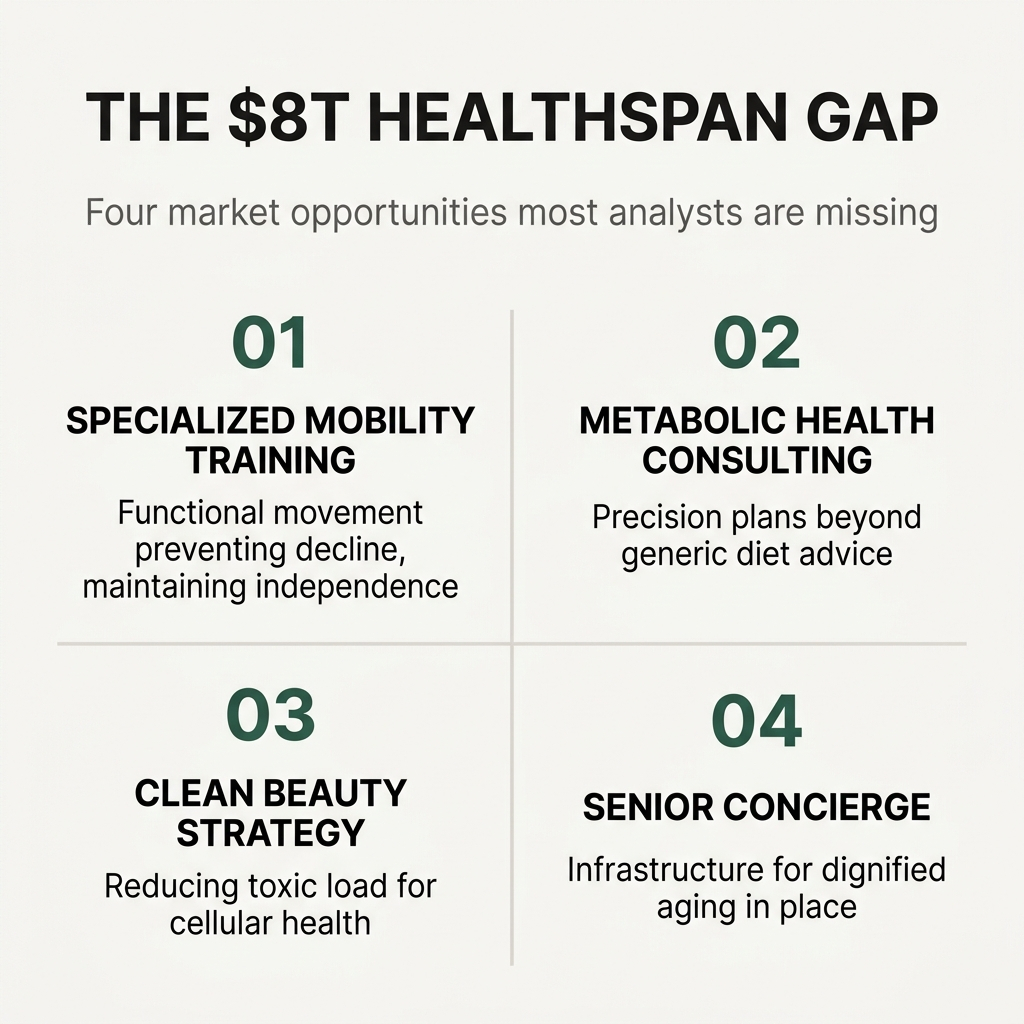
I see four distinct market opportunities emerging:
1. Specialized Mobility Training
This goes beyond standard personal training. Programs focus on balance, functional movement, and fall prevention. The target market is adults over 50 who want to maintain independence.
The value proposition is clear: prevent hospitalization, maintain quality of life, reduce long-term care costs.
2. Metabolic Health Consulting
Generic diet advice doesn't work. The precision medicine market is expected to grow from $137.9 billion in 2026 to $538.83 billion by 2035, expanding at a CAGR of 16.35%.
Personalized medicine now extends beyond pharmacological treatments. Healthcare providers analyze lifestyle habits, dietary preferences, physical activity levels, and stress management to develop personalized plans that are sustainable and effective.
The shift from generic to precision represents a fundamental change in how we approach metabolic health.
3. Clean Beauty as Cellular Strategy
This pillar focuses on reducing toxic load for better aging. The approach treats skincare and personal care products as part of a broader cellular health strategy.
Consumers are connecting the dots between environmental toxins and aging acceleration. The market for clean beauty products reflects this awareness.
4. Senior Concierge Services
This is the infrastructure of dignified aging. Services range from home modifications to care coordination to technology integration.
The business model addresses a simple reality: people want to age in place. They need support systems that make that possible.
The Economic Case for Prevention Over Treatment
Preventive healthcare and wellness held the largest share of 30.25% in 2025. The reason is growing awareness regarding health optimization and an increased preference for preventive healthcare compared to curative treatments.
Companies investing in healthspan extension see reduced healthcare costs and improved productivity. The ROI is measurable.
But there's a gender dimension worth noting. Globally, women exhibit a mean 2.4-year larger healthspan-lifespan gap than men. This is associated with a disproportionately larger burden of noncommunicable diseases in women.
This creates specific market opportunities for gender-tailored longevity services. It represents an underserved segment with significant purchasing power.
How Healthcare System Strain Creates Market Opportunities
The healthcare system is overwhelmed. Wait times are increasing. Costs are rising. Quality is inconsistent.
This strain creates openings for private market solutions. Consumers with resources are willing to pay for services that traditional healthcare doesn't provide.
The longevity market was estimated at $21.29 billion in 2024 and is projected to grow to $63.03 billion by 2035, exhibiting a compound annual growth rate of 10.37%.
This growth is driven by aging demographics and increasing awareness of age-related health concerns. But it's also driven by system failure.
When traditional healthcare can't deliver, markets fill the gap.
Why the Smartest Health Investments Look Nothing Like Gym Memberships
I've analyzed enough business models to recognize a pattern.
The most successful longevity businesses don't sell fitness. They sell functional independence. They don't sell supplements. They sell personalized metabolic optimization. They don't sell skincare. They sell cellular health strategies.
The difference is positioning.
Traditional fitness businesses compete on price and convenience. Longevity businesses compete on outcomes and personalization. The margins are different. The customer lifetime value is different. The business model is different.
Here's what smart investors are looking for:
Evidence-based protocols. No pseudoscience. No miracle cures. Just interventions backed by research.
Personalization at scale. The ability to customize while maintaining operational efficiency.
Measurable outcomes. Biomarkers, functional assessments, quality of life metrics. Data that proves value.
Integration across pillars. The best opportunities combine mobility, metabolic health, and lifestyle optimization.
Making Informed Decisions About Your Longevity Strategy
If you're evaluating opportunities in this space, here's my framework:
Assess the market gap. Where is traditional healthcare failing? Where are consumers willing to pay out of pocket?
Evaluate the evidence base. What interventions have high-certainty research support? What's just marketing?
Analyze the business model. Can this scale? What are the unit economics? How does customer acquisition cost compare to lifetime value?
Consider the regulatory environment. What claims can you legally make? What licensing requirements apply?
Examine the competitive landscape. Who else is serving this market? What's your differentiation?
The longevity economy represents one of the most significant market opportunities of the next decade. But like any emerging market, it rewards those who understand the fundamentals.
The shift from fitness to healthspan isn't just semantic. It's economic. And it's already happening.


No comments:
Post a Comment